Introduction
Most people spend hours writing content but often ignore how to structure headings for SEO, one of the simplest ways to improve rankings. When you apply proper heading structure, you unlock a highly effective technique that boosts both search visibility and user experience. Search engines rely on your headings to understand what your content is about, how deep it goes, and whether it deserves to appear on page one. At the same time, users rely on headings to read faster, scan better, and find answers without frustration. That is why mastering your heading hierarchy is essential if you want higher rankings, better engagement, and professional-quality content.
Understanding SEO Intent and Why Headings Matter
Why Search Intent Is the Foundation of Heading Structure
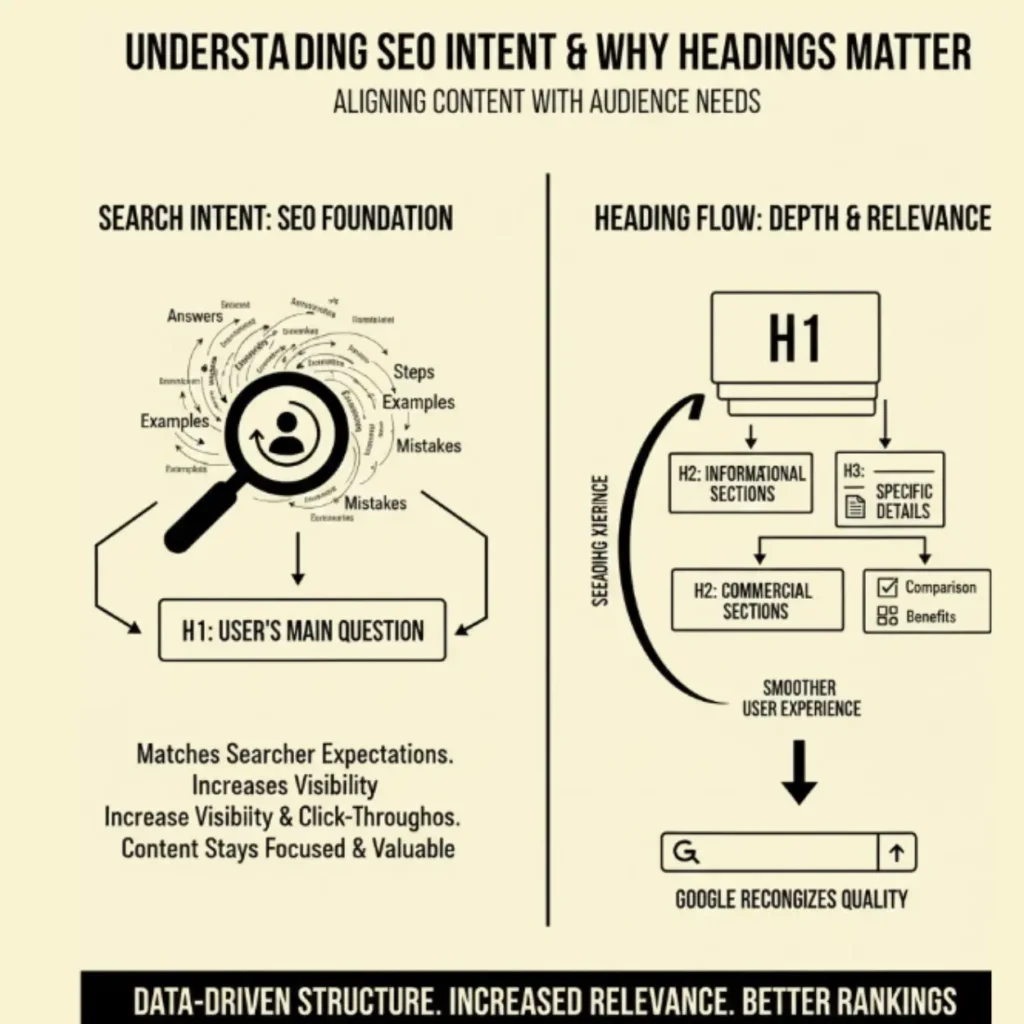
Every strong piece of content begins with understanding search intent and aligning your headings with it. Users searching for how to structure headings for SEO want answers, steps, mistakes, and examples, so your headings must reflect those expectations. When headings match what searchers want, Google immediately sees your content as relevant. This increases your visibility and improves your click-through rates. Structuring headings around search intent also ensures your content stays focused and valuable.
How Search Intent Shapes Heading Depth and Flow
Different types of intent require different types of heading structures to perform well. Informational content requires multiple H2 and H3 sections, while commercial content may include comparison and benefits headings. When your headings follow the natural flow of what the reader expects next, the user experience becomes smoother. Google uses this smoothness as a signal of high-quality content. Following intent-driven structure greatly improves the effectiveness of how to structure headings for SEO.
The Science Behind Heading Tags (H1–H6)
How Google NLP Interprets Headings
Google uses NLP (Natural Language Processing) to analyze headings and understand your content’s meaning. When you apply proper structure using H1 to H6, you help the algorithm categorize your main topics and subtopics. This makes it easier for search engines to understand the relationships between your ideas. When headings are logical, your semantic score improves, which boosts your ranking potential. That is why knowing how to structure headings for SEO is essential for modern optimization.
Understanding the Semantic Weight of H1, H2, and H3
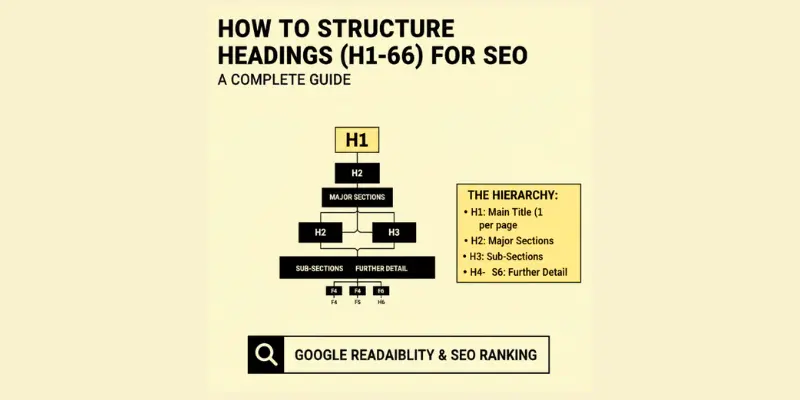
Not all heading levels carry equal importance in SEO. Your H1 communicates the main topic and must contain your primary keyword. H2s serve as major sections that support your H1, while H3s add details that support each H2. Using H4–H6 provides additional granularity and makes long content more digestible. The better your hierarchy, the stronger Google interprets your content quality.
How to Structure Your Heading Hierarchy Properly
Start With a Clear Outline Before Writing
Many writers jump into content without planning, but the smartest approach is outlining your headings first. An outline helps you organize your ideas so you can strategically place keywords and structure your content logically. It also ensures each section flows smoothly and follows a natural progression. This is vital when learning how to structure headings for SEO because a plan prevents keyword stuffing and repetition. Mapping your content early leads to stronger SEO performance.
Sample Heading Outline (Table)
| Heading Level | Purpose | Example |
| H1 | Main topic | How to Structure Headings for SEO |
| H2 | Main sections | Importance, Examples, Strategy |
| H3 | Sub-points | Keyword usage, hierarchy |
| H4 | Details | Tips, mistakes |
Turn User Questions Into SEO-Optimized Headings
Google rewards content that answers user questions, which makes this strategy incredibly effective. When you turn common search questions into headings, you align your content with user needs and search queries. This increases your chance of ranking in People-Also-Ask boxes and featured snippets. Headings like “How many H2s should I use?” or “Should heading tags include keywords?” can significantly improve SEO relevance. This method fits perfectly into how to structure headings for SEO because it boosts both keyword and intent alignment.
Keyword Strategy for Headings (Primary, Secondary, LSI, NLP)
Using Primary Keywords in Your H1 for Maximum Impact
Your H1 should always contain your primary keyword because Google reads it first to understand your main topic. It must be:
- Clear
- Specific
- Keyword-optimized
- Unique
- Only used once
A strong H1 sets the foundation for how to structure headings for SEO effectively. If the H1 fails, the entire page loses clarity.
Strategic Placement of Secondary and LSI Keywords in H2/H3
Overusing your primary keyword in multiple headings can lead to keyword stuffing. Instead, place secondary and LSI keywords in H2 and H3 headings naturally. Examples include:
- “heading hierarchy for SEO”
- “SEO-friendly headings”
- “using H1–H6 tags”
- “Google NLP for headings”
This maintains semantic richness without making your headings repetitive. It also boosts long-tail visibility.
Writing SEO-Optimized Headings That Engage Readers
Make Headings Clear, Simple, and Descriptive
A high-quality heading is easy to understand and clearly describes what the section covers. Users should instantly know what information they will get after reading it. Search engines prefer clarity over cleverness because they rely on headings to analyze content. When learning how to structure headings for SEO, simplicity is more powerful than complexity. Clear headings help both readers and algorithms.
Add Power Words to Increase Reader Interest
Power words make headings more compelling and help keep readers engaged. Words such as “effective,” “complete,” “proven,” and “ultimate” encourage users to continue reading. Google interprets high engagement as a sign of quality, which boosts ranking potential. Using emotional or action-driven words also increases click-through rates when headings appear in SERPs. This enhances the impact of your SEO strategy.
Structuring Headings for Long-Form Content
Break Big Topics Into Digestible Sections
Long-form content can feel overwhelming without proper structure. Using many H2 and H3 sections helps break the content into manageable parts that readers enjoy. This approach also increases readability scores and helps Google detect and index individual subtopics. When you master how to structure headings for SEO, long content becomes your biggest ranking asset. A good structure turns large guides into easy-to-scan educational pieces.
Use H4 and H5 Sparingly But Smartly
You don’t need to use H4–H6 in every article because they are optional. However, for technical or complex content, they help organize ideas into smaller chunks. These lower-level headings also strengthen semantic layering and improve NLP interpretation. They make your content more organized, especially in tutorials, case studies, or multi-step guides. Use them only when necessary to avoid overcomplicating the structure.
Common Heading Mistakes That Hurt SEO
Keyword Stuffing in Headings
One of the biggest mistakes is forcing keywords into every heading. Google penalizes unnatural heading structures, especially when the same phrase appears too often. While your focus keyword how to structure headings for SEO is important, it must appear naturally. Keyword stuffing reduces ranking potential and hurts readability. Always balance optimization with user experience.
Skipping Heading Levels or Using Them Incorrectly
Never jump from H1 to H4 or use headings just for design. This confuses both users and search engines because the hierarchy becomes unclear. Google expects a logical structure that moves from H1 to H2 to H3 and so on. Incorrect heading order weakens your topical authority and reduces semantic clarity. Always maintain a clean heading flow to maximize SEO performance.
SEO Checklist: Perfect Heading Structure
Manual Checklist (With Short Details)
Use this checklist while optimizing content to ensure your headings are clean, organized, and SEO-friendly.
One H1 per page
→ Always use a single H1 because it defines the main topic of your content and helps Google understand your focus.
H2 for main sections
→ Use H2 headings to break your content into logical major sections that guide both readers and search engines.
H3 for supporting ideas
→ Add H3 headings under each H2 to explain details, examples, or sub-points that support the main topic.
Logical order (no skipping levels)
→ Maintain a clear flow from H1 → H2 → H3 → H4 without jumping levels, as it improves readability and semantic structure.
Include primary keyword once
→ Place your main keyword naturally in the H1 or an important H2, avoiding overuse to prevent keyword stuffing.
Use LSI/NLP keywords in H2/H3
→ Add related phrases and semantically connected keywords in your sub-headings to boost contextual relevance.
Keep headings short and clear
→ Make your headings easy to read and understand so users can quickly scan and find the information they need.
Tools to Analyze Heading Structure (With Short Details)
These SEO tools help you identify heading errors, improve structure, and optimize your content.
Ahrefs Site Audit
→ Scans your website for heading issues, duplicate H1s, and missing tags.
RankMath Content AI
→ Gives real-time suggestions for keywords and heading optimization while writing.
Surfer SEO
→ Analyzes competitor heading structures and helps you match top-ranking content.
Yoast SEO
→ Flags heading problems directly inside WordPress and offers readability improvements.
Screaming Frog
→ Crawls your entire site to detect inconsistent heading levels and structural issues.
These tools reveal missing headings, misplaced tags, and opportunities to improve keyword placement.
Practical Examples of Perfect Heading Structures
Example for a Blog Post (With Short Details)
H1: How to Structure Headings for SEO
→ This is your main topic and should include your primary keyword clearly.
H2: Why Headings Matter
→ This section explains the importance of headings in readability, SEO, and user experience.
H3: User Intent
→ Describe how understanding what users search for helps you create better headings.
H3: Google NLP
→ Explain how Google’s Natural Language Processing reads headings to understand your content.
H2: How to Use H1–H6
→ Guide readers on how to apply each heading level correctly for structure and clarity.
H3: Best Practices
→ Provide tips such as using one H1, logical order, and keyword placement.
H3: Mistakes to Avoid
→ Highlight common errors like keyword stuffing or skipping heading levels.
Example for a Product Page (With Short Details)
H1: Product Name + Main Keyword
→ The main page title that tells Google and users what the product is.
H2: Features
→ List the key features to help readers understand what the product offers.
H3: Benefits
→ Explain how the features improve the customer’s life or solve a problem.
H2: Price & Options
→ Share pricing details, variants, colors, sizes, or subscription plans.
H2: FAQs
→ Answer common customer questions to improve trust and boost conversions.
H2: Specifications
→ Provide technical details, measurements, materials, and other important data.
Example for a Service Page (With Short Details)
H1: Service Name + Intent Keyword
→ Make the main title clear by including your service and a keyword like “best,” “top,” or “expert.”
H2: What You Get
→ Explain what the customer receives when they purchase or hire your service.
H2: Why Choose Us
→ Highlight your experience, unique advantages, and why you stand out in the market.
H2: Pricing
→ Include transparent pricing, packages, or custom quote details.
H2: FAQs
→ Provide answers to questions users often ask before hiring a service.
Optimize Your Content Today
If you’re ready to take your SEO to the next level, now is the perfect time to start applying these strategies. Begin by reviewing your existing content and restructuring your headings using the techniques from this guide. Small changes in your heading structure can create massive improvements in rankings, traffic, and user engagement. Don’t wait for your competitors to outrank you take control of your SEO performance today. Start optimizing your H1–H6 headings now and watch your content rise to the top of search results.
Conclusion
Learning how to structure headings for SEO is one of the most valuable skills in modern content writing. Proper heading usage improves readability, strengthens semantic signals, and helps search engines understand your content. When your content is easier for Google to interpret, it becomes easier for you to rank higher. Clear headings also keep readers engaged longer, improving behavioral metrics that impact SEO. By implementing the strategies in this guide, you will create professional, powerful, and optimized content that stands out in search results.
FAQs
How many H2s should I use?
As many as needed to explain your topic clearly. Each major idea deserves its own H2 heading.
Should every page have an H1?
Yes, always one H1 and only one. It tells Google the main topic of the page.
Can headings improve ranking?
Yes, both directly and indirectly through semantic clarity and user engagement. Strong headings help Google understand your structure.
Do I need to use all heading levels (H1 to H6)?
No, you only need to use the levels required for your content. Use H4–H6 only when your topic has deeper sub-points.
Should I include keywords in every heading?
Not at all that becomes keyword stuffing. Use your primary keyword once and add LSI/NLP keywords naturally in a few headings.
Can two pages have the same H1?
They can, but it’s not recommended. Each page should have a unique H1 so search engines can differentiate content.
Is it okay to repeat the same heading on multiple pages?
Avoid repeating identical headings across pages unless it’s part of a template. Too much repetition can weaken SEO signals.
Does heading length matter for SEO?
Yes, headings should be short, clear, and easy to understand. Long or confusing headings reduce readability and impact.
Can emojis be used in headings?
They can, but use them sparingly. Emojis may improve engagement but can look unprofessional in some niches.
Do headings affect Featured Snippets?
Absolutely. Well-structured, question-based headings increase your chances of winning People-Also-Ask and snippet results.
Should headings be written in title case or sentence case?
Both are acceptable, but maintain consistency throughout the page. Choose the format that matches your brand style.
Do headings help with accessibility?
Yes, headings help screen readers understand the content structure, improving accessibility for users with visual impairments.