
Introduction
The future of search is changing faster than ever, and brands that fail to adapt will lose visibility where audiences spend most of their time. AI chat tools like ChatGPT, Perplexity, and Google AI Mode have changed how people search for answers. They no longer scroll through pages of links; they expect instant, accurate, conversational responses. This shift has created a new opportunity for brands willing to optimize for chat-based visibility. If you want to stay ahead, you must understand how in-chat search optimization works right now.
Today’s search behavior rewards brands that appear inside AI conversations, not just on traditional search pages. That means optimizing your content for discovery inside chat interfaces, AI answer engines, and zero-click environments. This blog will guide you through the most important strategies to help you rank inside AI chat platforms. You’ll learn what AI models look for, how to structure content for chat responses, and how to future-proof your SEO strategy. Get ready this is your roadmap to visibility in the age of conversational search.
The New Search Paradigm
AI chat platforms have changed how search results appear, and this shift demands a new approach. Users now search through conversations instead of browsing long lists of links. This creates a zero-click world where answers matter more than rankings. Brands that understand this shift gain visibility where audiences already search. To win today, you must optimize for AI-generated responses, not just blue links.
This new search paradigm values clarity, credibility, and answer-ready content. Google AI Mode and ChatGPT now act as answer engines that summarize information instantly. Your brand must appear as a trusted source inside these summaries. This means refining your content to serve user intent quickly and directly. When you do this, your visibility grows across chat-based search environments.
What Makes AI Search Engines Different?
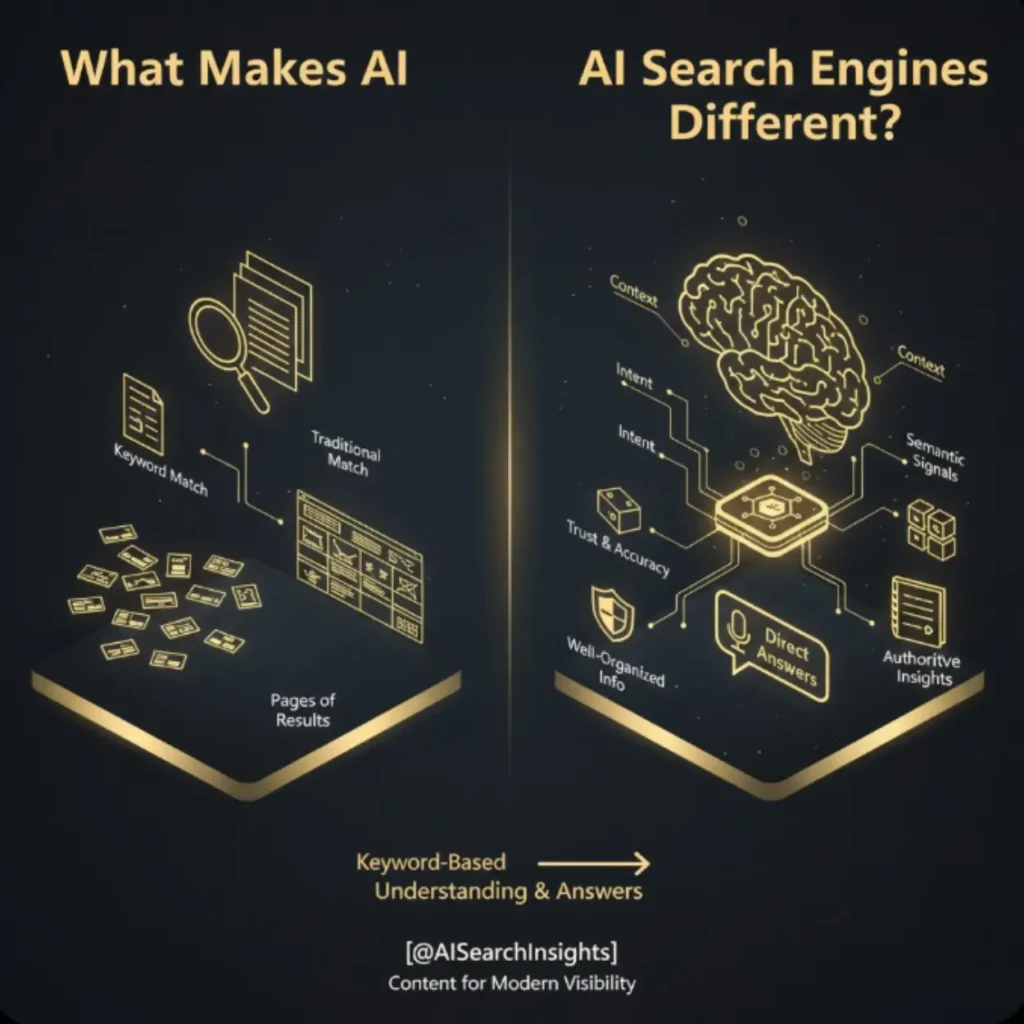
AI search engines work differently from traditional search systems. They do not just match keywords they understand context, intent, and structure. Instead of displaying pages of results, they generate direct answers. This makes in-chat search optimization essential for modern visibility. Brands must now focus on how AI interprets and uses their content.
Unlike traditional search, AI-driven platforms rely heavily on semantic signals. AI systems look for compact, well-organized information that fits naturally into conversational answers. Content that delivers clear and authoritative insights tends to perform better. Sources that demonstrate strong trust and accuracy are also prioritized in AI-driven results. This means your brand must deliver content that AI can easily ingest, understand, and quote.
Key Differences Between AI Search and Traditional Search
AI search engines generate answers instead of listing links. AI engines evaluate content based on clarity, authority, and relevance. They interpret user intent far more deeply than traditional search tools. Content that directly solves a user’s problem is given significantly higher priority. This requires a different content strategy to win visibility.
While traditional search focuses on ranking pages independently, AI evaluates the full context of your content ecosystem.AI systems read your headings, summaries, and internal links to understand your authority. Semantic signals help them determine how trustworthy your content is. They also check whether your information aligns with real-time user intent before surfacing it in results Winning inside chat begins with creating content that fits these expectations.
How AI Models Choose and Surface Content
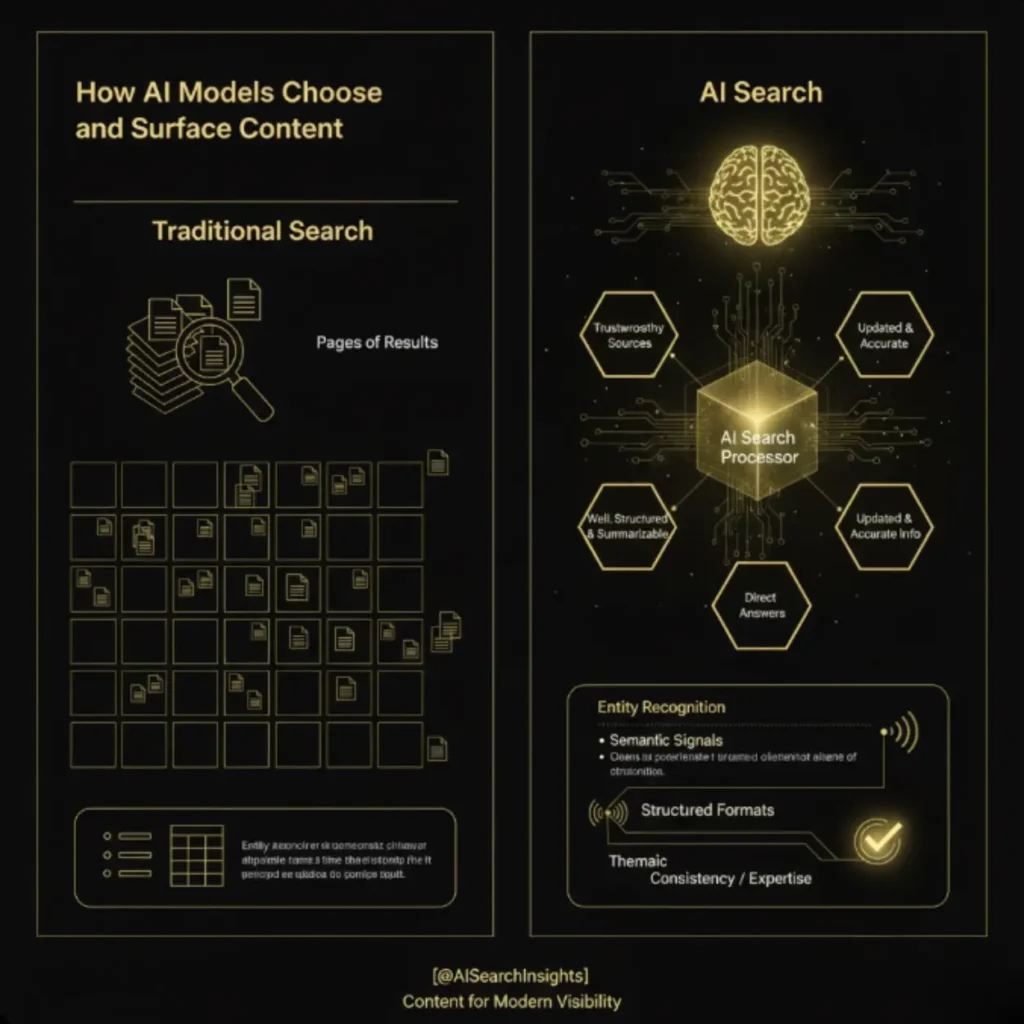
AI models surface content based on several high-impact factors.AI systems favor trustworthy sources with strong domain authority. Well-structured content that’s easy for them to summarize performs even better. Updated and accurate information consistently ranks higher in AI-driven answers. Content that directly addresses specific user questions also has a stronger chance of being selected.
AI also uses entity recognition and semantic signals to evaluate relevance. This means each section of your content should be organized for clarity. Using structured formats like bullets and tables increases your chance of being used in AI answers. AI systems also evaluate your consistency across related topics. When your site covers a theme deeply, AI treats you as an expert.
Authoritativeness and Domain Credibility
Brand credibility plays a major role in AI search visibility. AI platforms prefer content from domains with proven experience and trust. They look at backlinks, brand mentions, and accuracy to measure authority. They also consider your publishing history and expertise. Strong authority increases your chances of surfacing in chat-based search.
To strengthen authority, publish content consistently. Share insights backed by research or direct experience. Build topical depth across your niche. Get mentioned by credible sources and collaborate with industry leaders. These actions establish the authority AI engines prefer.
Structured, Well-Formatted Content
AI engines extract answers from content that is clear, structured, and easy to digest. They prefer short paragraphs, bullet points, and descriptive headings. They ignore messy or confusing formatting. Clear structure helps AI understand your content faster. This boosts your chance of being cited in AI-generated responses.
Use proper formatting like H2/H3s and logical grouping. Add summaries at the end of major sections. Create mini answer blocks for common questions. Add lists and tables wherever they enhance clarity. These structural elements support strong in-chat search optimization.
Content That Reflects User Intent
AI search engines analyze user intent and deliver answers that match needs. AI models expect content that speaks directly to user goals. They give higher visibility to pages that solve problems clearly and quickly. Information that matches the user’s exact search moment is far more likely to be highlighted. This makes intent-based writing a crucial skill.
To align with user intent, study real questions people ask. Create content that addresses those questions directly. Use simple explanations supported by examples. Provide actionable steps to strengthen value. This increases your chance of being selected by AI answer engines.
Up-to-Date and Relevant Pages
AI tools prefer fresh content over outdated material. AI systems continuously scan the web for fresh information. Sites that update and refine their content regularly are rewarded with higher visibility. Pages containing outdated or incomplete details are often downgraded in AI-generated results. Keeping content updated is now part of in-chat search optimization.
Set a schedule to refresh top-performing pages. Add new data, insights, and examples. Update FAQ sections based on emerging user questions. Re-check internal links to maintain relevance. These updates help AI tools trust your content.
Answer-Like Content Blocks
AI tools extract information from well-structured answer blocks. AI tools use these blocks to create clear and concise responses. Content that explains topics in simple, easy-to-understand sentences performs best. Clarity, precision, and direct information are highly valued in AI search results. Answer blocks increase visibility inside automated summaries.
Create short sections that answer “What,” “Why,” and “How” questions. Add definitions and explanations in plain language. Use 1–2 sentence summaries where possible. Provide clear value in every block. These techniques make your content easier for AI systems to reuse.
Schema Markup and Semantic Signals
Schema markup helps AI understand your content more deeply. It provides structured data that clarifies meaning. It signals topics, authors, ratings, and important entities. AI uses these signals to assess trust and relevance. Schema enhances your in-chat search optimization.
Add FAQ schema, article schema, and breadcrumb schema. Mark your business details with organization schema. Use product or service schema for commercial pages. Keep your structured data validated through testing tools. This improves visibility across chat-based search systems.
Ranking in AI Search (ChatGPT, Perplexity, Google AI Overviews)
Ranking in AI platforms begins with understanding how these models read your content. AI systems scan pages for clarity, structure, and authority. They assess your site’s expertise and the depth of your topical coverage. Content that delivers instant, accurate answers is far more likely to appear in AI-driven search results. You will rank higher when your content fits these standards.
To rank inside chat-based search, focus on answer-driven writing. Use crisp, clear language that AI models can easily quote. Add summaries at the end of sections. Provide actionable steps and insights users can apply immediately. This style increases your visibility across AI-driven search platforms.
How to Rank in AI Search: Boost Visibility Across AI Answer Engines
AI answer engines reward content that solves problems quickly and clearly.AI tools prefer short, clear explanations presented in easy-to-read sections. Fresh, credible, and relevant information is more likely to be highlighted. Pages that are confusing, poorly structured, or overly complex tend to be ignored.
Focus on providing answers users want right now. Organize content around real user questions. Create lists of tips, steps, or examples. Add practical advice that users can apply immediately. These approaches improve ranking inside conversational search tools.
Measuring and Improving AI Visibility
Measuring AI visibility helps you understand how well your content performs. Traditional ranking tools don’t show your true performance in chat-based search. You must test your content directly inside AI platforms. You also need to track impressions, summaries, and brand mentions. These signals reveal your actual visibility level.
Use AI search testing as part of your SEO process. Run your brand queries inside ChatGPT, Perplexity, Gemini, and Claude. Check if your information appears in AI responses. Analyze how your brand is summarized across platforms. This helps you optimize with precision.
Measuring AI Visibility
Visibility inside AI search engines depends on inclusion and recognition. AI must acknowledge your content as useful and credible. This requires strong structure, authority, and clarity. When AI uses your content, your visibility increases. Understanding this helps you improve your performance.
Create your own tracking system for AI visibility. Monitor how often AI platforms mention your brand or content. Track summaries, inclusions, and answer placements. Compare visibility across multiple AI tools. This helps refine your strategy.
Rank No Longer Equals Reach
Traditional rankings do not guarantee visibility inside AI search. AI platforms generate answers without showing links. This reduces the value of traditional SEO alone. It also shifts attention toward conversational presence. This makes in-chat search optimization essential.
Focus on visibility inside answers, not just ranking pages. Create content that earns citations inside chat tools. Build authority through clear explanations and structured insights. Be present wherever AI platforms gather information. This creates stronger reach than old ranking systems.
First-Party Data & Brand Content in AI Search
First-party data gives your brand a major advantage in AI search. AI platforms trust content sourced directly from brands. They look for original research, case studies, and insights. They prefer trustworthy, unique material. This increases your visibility inside chat-based results.
Focus on publishing strong first-party content. Showcase your expertise through detailed examples. Share real data from your business or niche. Build a library of valuable information. This boosts your credibility inside AI systems.
The Metrics That Matter Now
New visibility metrics define success in the era of AI search engines. AI rewards trust, clarity, and structure. It values updated information and correct answers. It prefers short, direct explanations. These factors shape your content strategy.
Monitor content clarity, authority, and engagement. Track how users interact with your pages. Measure summaries, impressions, and AI citations. Optimize based on user behavior and AI testing. This gives you clear direction for improvement.
Building the New AI-Search Measurement Framework
A strong measurement framework helps you stay competitive. AI search environments change rapidly. You must track visibility across multiple platforms. You should analyze both traditional and conversational signals. This gives a full picture of your performance.
Build a multi-layer visibility system. Combine keyword data with AI chat testing. Track mentions and summaries inside chat tools. Use engagement analytics to guide updates. This forms a reliable measurement framework.
Upholding Credibility and Brand Integrity
Credibility is the key to winning AI visibility. AI engines evaluate trust signals carefully. They avoid content with misleading or weak information. They select brands that maintain integrity. This creates a strong foundation for visibility.
Protect your brand reputation by keeping information accurate. Use trustworthy sources and cite your claims. Maintain a consistent voice across your content. Deliver high-quality insights your audience can trust. This increases your value to AI engines.
Future-Proofing Your SEO Strategy in an AI-First World
Future-proofing your SEO requires adapting to AI-driven search. You must focus on clarity, authority, and structured answers. You must also optimize for conversational relevance. This means adopting new optimization strategies. This helps secure long-term visibility.
Prepare content for conversational extraction. Build pages that speak directly to user needs. Update your content frequently to stay relevant. Use schema markup to strengthen understanding. These strategies keep your brand competitive.
Checklist: Is Your Content AI-Search Ready?
Use this checklist to evaluate your content:
- Does your content answer common user questions?
- Is your domain authoritative and credible?
- Do you update content regularly?
- Are your headings descriptive and organized?
- Do you include key takeaways or summaries?
- Is your content optimized for semantic search?
- Have you added schema markup?
- Is your site mobile-friendly and fast?
- Is your internal linking helpful and relevant?
- Have you tested your content inside AI chat tools?
Takeaway: Stay Ahead in the Age of AI Search
AI-driven search is reshaping how users discover brands. Visibility now depends on how well your content performs inside chat tools. The brands that adapt quickly will gain the strongest advantage. Those who wait will lose reach and influence. Now is the time to invest in in-chat search optimization.
Ready to Take Your Business From Great to Awesome?
If you want your brand to show up inside ChatGPT, Perplexity, and Google AI Mode, you need a strategy built for AI-first search. At Mugenz, we help businesses optimize their content, structure their pages, and capture visibility across all major AI chat platforms. With our proven approach to in-chat search optimization, your brand can become more discoverable, authoritative, and trusted in AI-driven search results.
Send us a message at Mugenz to start your AI Search Optimization plan today.
Conclusion
In-chat search optimization is no longer optional. It is now one of the strongest ways to secure visibility where your audience actually searches. As AI chat platforms continue to replace traditional search habits, brands that adapt early will earn more clicks, more authority, and more conversions. This shift is creating a new competitive landscape where answer-ready content, structured data, and conversational clarity matter more than ever. If you want your business to stay visible, you must create content that AI can understand, index, and deliver instantly. When your message meets your audience exactly at the moment they ask, your brand becomes the trusted choice. By applying these strategies consistently, you position yourself to dominate AI-driven search experiences today—and in the future.
FAQs
1. How do AI engines choose what content to show?
They analyze structure, clarity, and authority. AI engines select content that answers questions directly and concisely. They also prefer trusted brands with strong semantic signals. Content that is well-formatted with headings and bullet points is easier for AI to surface. Regularly updating your content increases its chances of appearing in AI-generated answers.
2. How often should I update my content?
Update important pages every few months. Refresh older posts with new insights. This increases your chance of being included in AI answers. Adding new data, examples, and relevant internal links also helps. Consistency in updating signals reliability to AI models.
3. Are backlinks still important?
Yes, but they matter differently. AI uses backlinks to measure trust and authority. Strong backlink profiles boost your visibility across chat-based search. High-quality, relevant backlinks are more valuable than a large number of low-quality links. Focus on earning links from authoritative sites in your niche.
4. What is in-chat search optimization?
In-chat search optimization is the process of structuring and formatting content so that it can be discovered and surfaced by AI chat tools. It focuses on clarity, relevance, and authority. Content is optimized for conversational queries rather than traditional search ranking. This helps your brand appear directly in AI-generated answers. It is crucial for maintaining visibility in AI-driven search environments.
5. Can schema markup improve AI visibility?
Yes. Schema markup helps AI understand your content’s structure and purpose. FAQ, Article, and Product schema highlight key information for AI tools. Structured data increases the chances of being featured in AI-generated responses. It also helps your content stand out in zero-click environments.
6. How do I optimize content for AI answer engines like ChatGPT or Perplexity?
Focus on creating concise, well-structured, and authoritative content. Use clear headings, bullet points, and tables to organize information. Align content with real user intent and frequently asked questions. Include first-party data and actionable insights. Regularly monitor AI tools to see if your content appears in responses and adjust accordingly.
7. Is traditional SEO still relevant in AI search?
Yes, but it is no longer enough alone. Traditional SEO practices like keyword research, on-page optimization, and backlinks still matter. However, AI search prioritizes clarity, intent fulfillment, and structured, answer-ready content. Combining traditional SEO with in-chat search optimization gives the best results. Brands that ignore AI-focused strategies may lose visibility over time.
8. How do I test if my content is AI-search ready?
You can test by querying AI tools like ChatGPT, Perplexity, or Google AI Mode with relevant user questions. See if your content appears in responses or summaries. Evaluate the clarity, relevance, and completeness of answers. Make adjustments based on how AI interprets your content. Regular testing ensures your content stays optimized for evolving AI search models.
9. Can AI chat tools replace traditional search traffic?
They are not fully replacing it yet, but AI chat is reducing click-through rates for many queries. Users get answers directly inside the chat interface, bypassing traditional search links. Optimizing for in-chat search ensures your brand is visible even in a zero-click environment. Combining traditional SEO with AI optimization provides a balanced strategy. Brands that ignore AI chat risk losing discoverability over time.
10. How do I future-proof my content for AI-driven search?
Focus on clarity, structure, and authority. Use answer-ready content blocks and semantic optimization. Keep content updated with accurate information and first-party data. Implement schema markup and test your content in AI tools regularly. Staying informed about AI search trends ensures your content remains competitive.