Introduction
Advertising is the backbone of modern business growth. In 2026, digital advertising platforms like Google Ads vs Meta dominate the market. Many businesses are asking, “Which platform actually delivers better ROAS?” This question is crucial because choosing the wrong platform can waste budgets. In this blog, we will explore the strengths and weaknesses of both platforms to help you make the best decision.
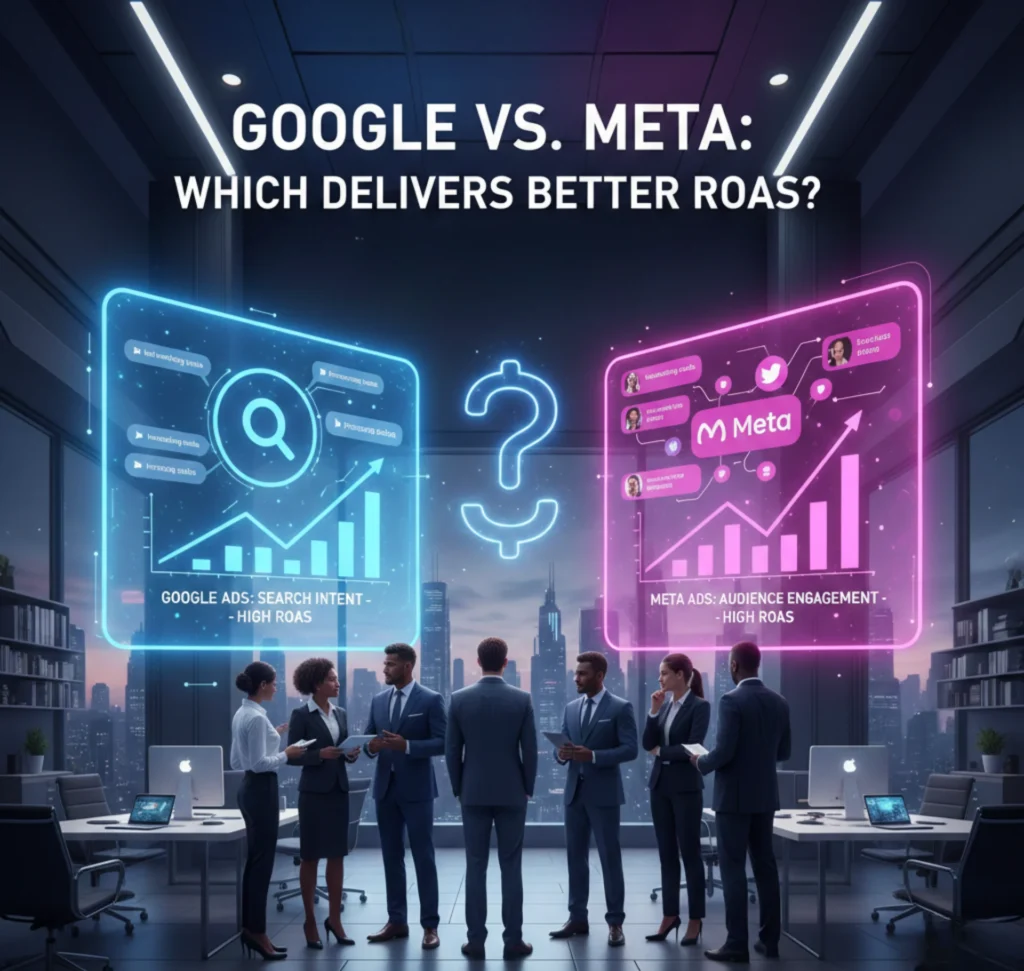
Both platforms provide powerful tools for businesses of all sizes. Google Ads excels in search intent, while Meta Ads thrives on audience engagement. Each has its own pricing model, targeting capabilities, and return on investment. By the end of this blog, you’ll know how to decide where to invest your ad budget. Let’s dive in.
What is Google Ads?
Google Ads is a paid advertising platform where businesses show ads on Google search results, YouTube, and partner sites. It targets people actively searching for products or services. This makes it ideal for high-intent traffic. It runs on an auction model where advertisers bid for keywords. The higher the relevance, the better the ad ranking.
What is Meta Ads?
Meta Ads includes Facebook, Instagram, Messenger, and Audience Network. It is built around audience targeting based on interests, behaviors, and demographics. Unlike Google, it doesn’t wait for users to search it puts ads in front of them. This makes it effective for awareness and demand generation. Its visual format also helps with storytelling and brand recognition.
Similarities Between Google Ads vs Meta
Both platforms rely on pay-per-click (PPC) models. Both allow detailed audience targeting and offer multiple ad formats. Each provides analytics dashboards for measuring success. Businesses of any size can start with small budgets. Both have global reach, allowing advertisers to scale campaigns internationally.
Key Differences Between Google Ads vs Meta
Google Ads focuses on intent-based search, while Meta Ads focuses on interest-based discovery. Google is better for lead generation and direct sales, while Meta shines in brand awareness. Pricing models differ depending on campaign goals. Google offers search, display, and video ads, while Meta focuses on visual and social formats. Both platforms have unique strengths, and knowing when to use each is key.
Alternatives to Google Ads vs Meta
Other platforms are also rising in popularity. TikTok Ads are strong for Gen Z engagement. LinkedIn Ads work well for B2B targeting. Pinterest Ads perform in lifestyle niches. Twitter Ads can help with trending topics and quick engagement. Each platform serves different goals, so businesses often combine them with Google and Meta campaigns.
Google Ads vs Meta Ads: Audience and Reach Compared
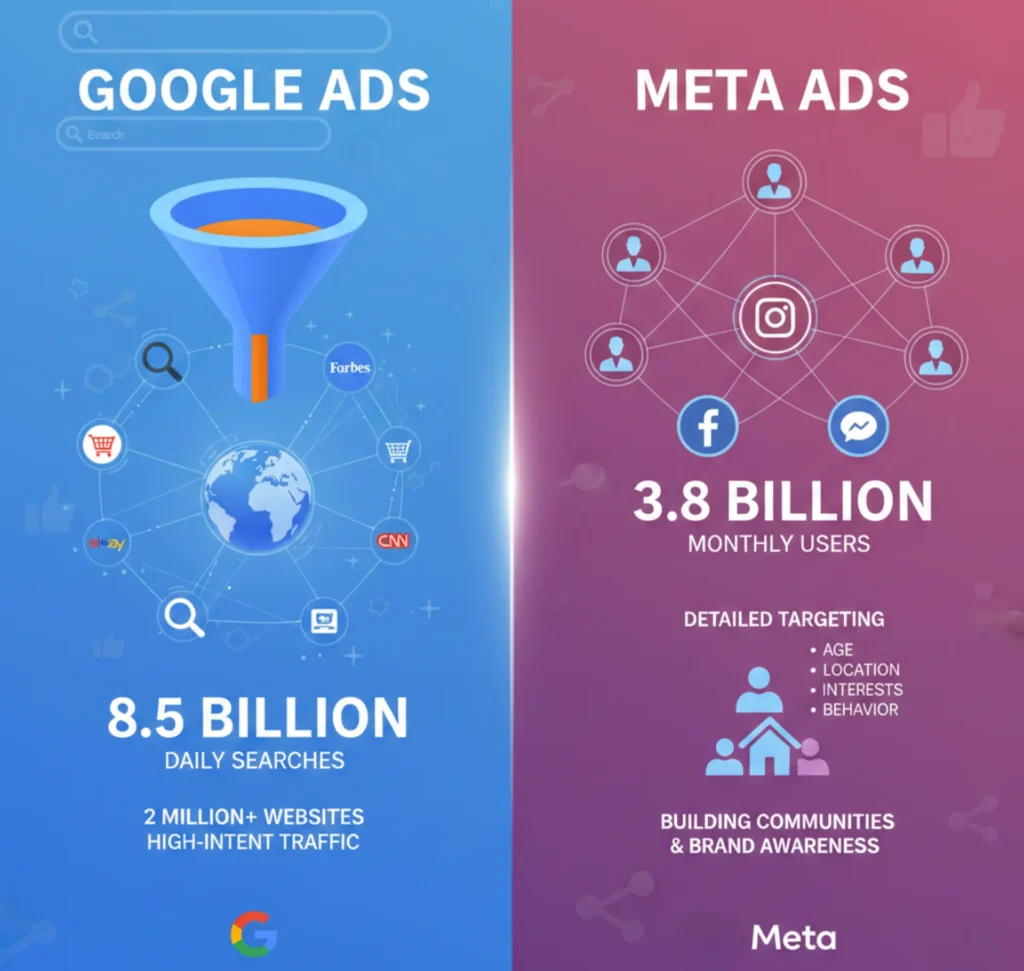
Google Ads taps into 8.5 billion daily searches. This makes it powerful for capturing customers ready to buy. Its reach covers the Google Display Network, which spans over 2 million websites. For advertisers, this means huge exposure to high-intent traffic. Google Ads is unmatched when users are already in buying mode.
Meta Ads reach over 3.8 billion active users monthly. This includes Facebook, Instagram, and Messenger combined. The strength lies in detailed targeting. Brands can reach audiences based on age, location, interests, and even online behavior. This makes Meta a leader in building communities and brand awareness.
Google Ads vs Meta Ads: Cost and Pricing Model Compared
Pricing is one of the top concerns for advertisers. Google Ads works on a cost-per-click (CPC) model. The cost depends on keyword competition. High-value industries like finance and law often see CPCs of $20 or more. However, advertisers benefit from high-quality leads due to strong purchase intent.
Meta Ads works on CPC and CPM (cost per thousand impressions). Costs are usually lower than Google, often ranging from $0.50 to $2 per click. This makes it attractive for businesses with smaller budgets. However, the challenge is converting users who weren’t actively searching. This requires strong creative and engagement tactics.
Cost Comparison Table
| Feature | Google Ads | Meta Ads |
| Average CPC | $1 – $20+ | $0.50 – $2 |
| Pricing Model | CPC, CPA | CPC, CPM |
| Best for | High-intent buyers | Brand awareness & engagement |
| ROI Potential | High with targeting | Moderate to high with strong creative |
Google Ads vs Meta Ads: Ad Formats Supported Compared
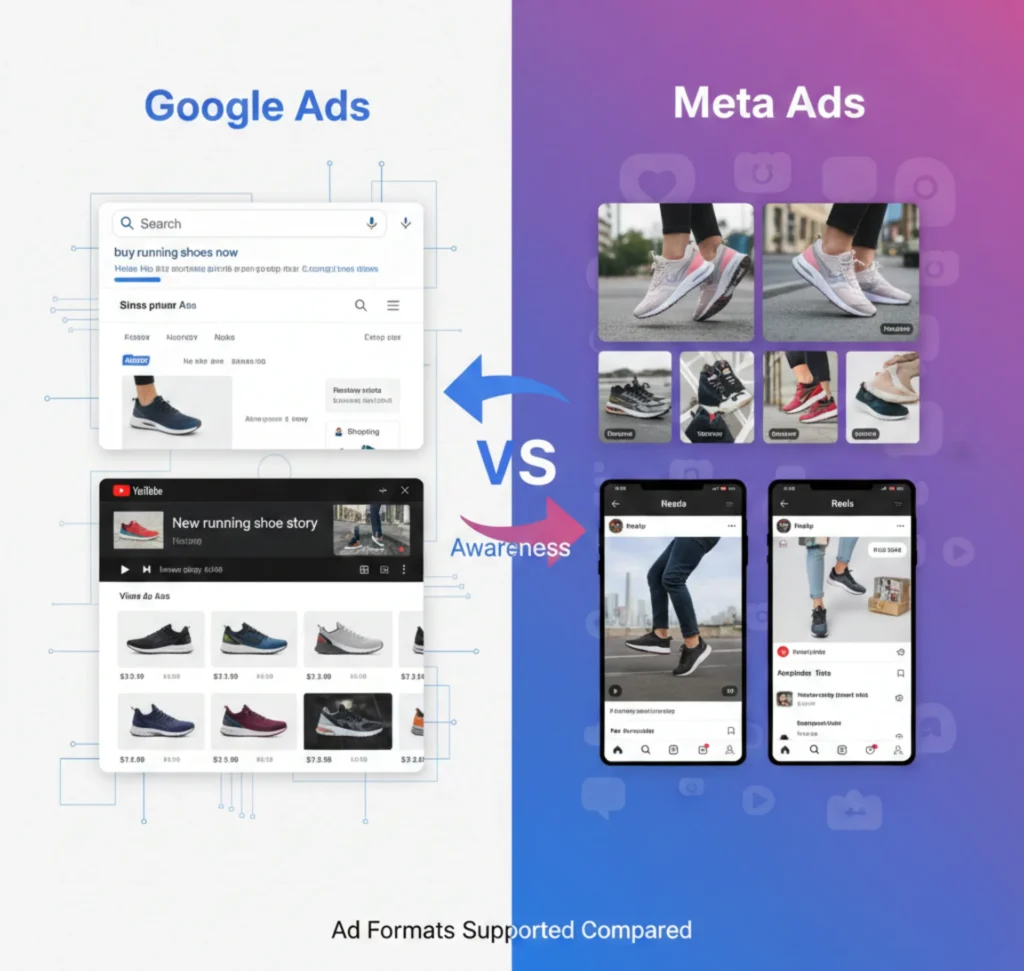
Google Ads offers multiple ad formats. These include search ads, display ads, video ads on YouTube, and shopping ads. Each format is tailored to different stages of the buyer journey. Search ads target immediate intent, while display ads create awareness. Shopping ads are ideal for eCommerce, and video ads are powerful for storytelling.
Meta Ads are more visually engaging. Formats include photo ads, carousel ads, video ads, stories, and reels. These formats thrive on platforms like Instagram. They are ideal for showcasing products, lifestyle branding, and community engagement. With interactive features, Meta makes ads feel more personal.
Google Ads vs Meta Ads: Analytics and Reporting Compared
Google Ads provides detailed analytics through Google Analytics integration. Advertisers can track conversions, cost per lead, ROI, and even customer journey. Data transparency is one of its strongest advantages. It helps advertisers understand where every dollar is spent. Businesses can adjust campaigns quickly with clear data insights.
Meta Ads Manager also provides in-depth reporting. Metrics include engagement, impressions, reach, and conversions. It highlights audience behavior, making it useful for retargeting strategies. Meta also allows A/B testing for creative performance. While less detailed than Google Analytics, it provides actionable insights for campaign optimization.
Third-Party Integrations Compared: Google Ads vs Meta
Google Ads: Integrations
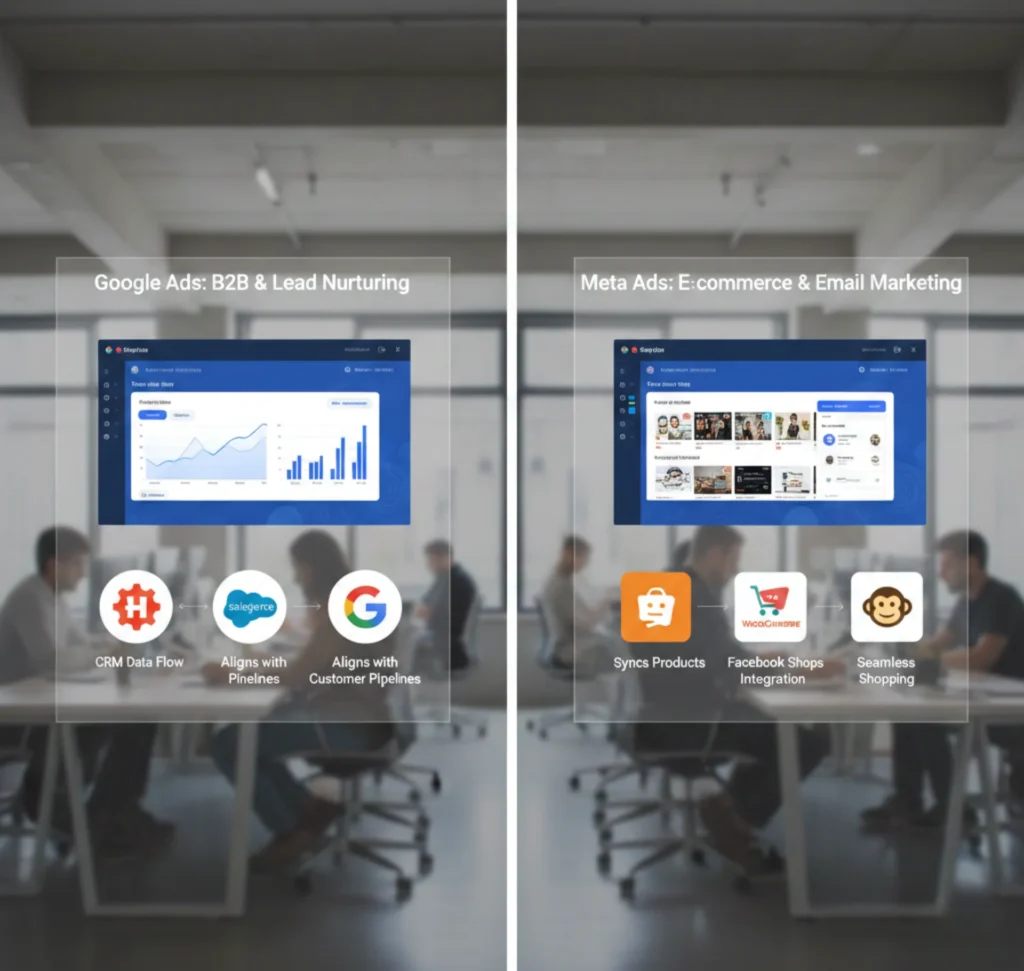
Google Ads integrates with tools like HubSpot, Salesforce, and Google Analytics. This makes it powerful for B2B and lead nurturing. Integration with CRMs ensures smooth data flow. Businesses can align ad performance with customer pipelines. This boosts efficiency and reporting accuracy.
Meta Ads: Integrations
Meta Ads integrates with Shopify, WooCommerce, and Mailchimp. This makes it strong for eCommerce and email marketing. Shopify users, for example, can sync products directly into Facebook Shops. This creates seamless shopping experiences. Integrations make it easier for small businesses to manage everything in one place.
Google Ads vs Meta Ads for eCommerce
Google Ads is a top performer in eCommerce. Shopping ads allow customers to see product images, prices, and reviews directly in search. This builds trust and speeds up buying decisions. It works best for products people already want. High-intent clicks often lead to quick conversions.
Meta Ads help eCommerce brands through discovery. Instagram shopping, reels, and carousel ads drive engagement. They showcase products in lifestyle contexts, building emotional connections. This helps with impulse purchases. Many brands use Meta Ads to generate demand before users even search.
Google Ads vs Meta Ads: Best for Small Businesses
Small businesses must carefully manage budgets. Google Ads is great for local businesses targeting people actively searching. For example, a local plumber can attract leads from nearby searchers. It is measurable and scalable. However, it can become costly if not managed well.
Meta Ads are affordable and flexible for small businesses. A small boutique can use Instagram ads to reach local fashion lovers. Story ads allow small budgets to compete with bigger brands. It is also easier to test creative ideas. For many small businesses, Meta Ads are a low-cost entry point.
Which Platform Delivers Better ROI in 2026?
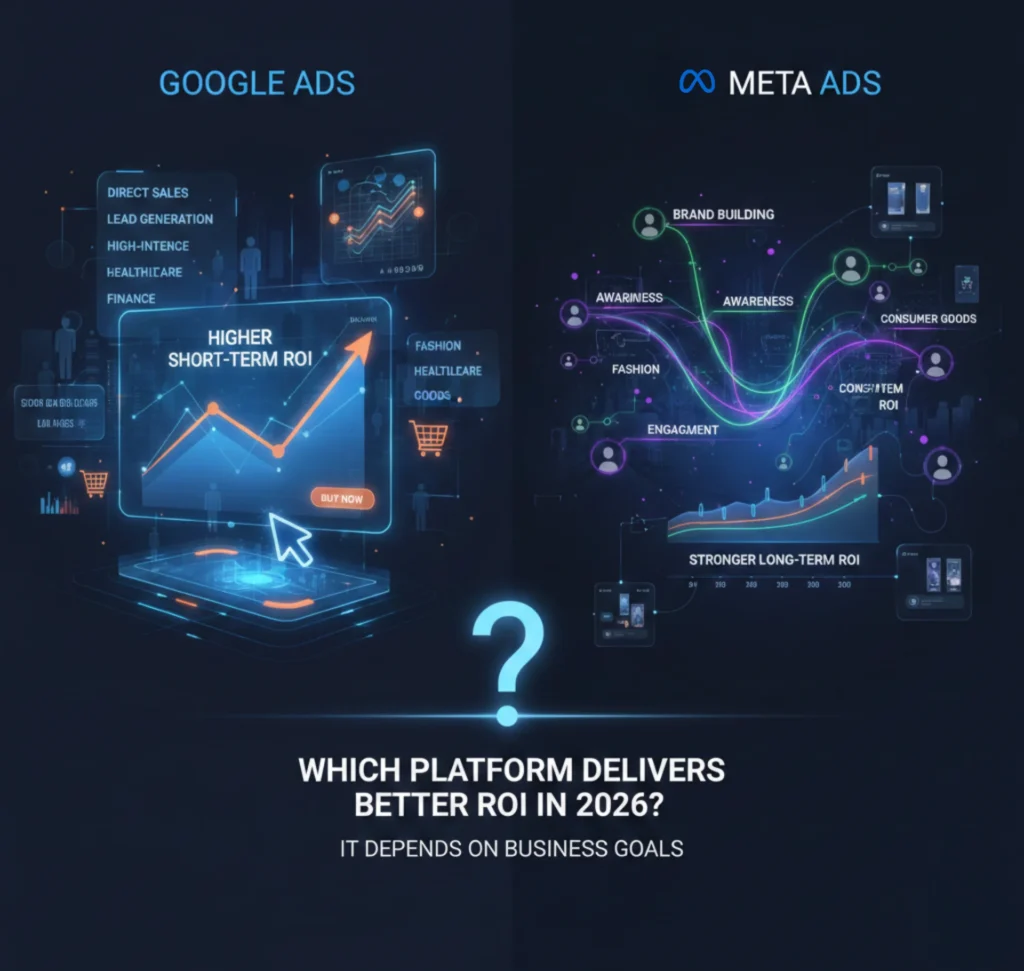
Return on investment depends on business goals. Google Ads delivers better ROI for direct sales and lead generation. It targets people ready to buy, making it efficient for conversions. Industries like healthcare, finance, and eCommerce thrive here. Its strength lies in intent-driven advertising.
Meta Ads deliver better ROI for brand building. They create awareness and community engagement. While conversions may take longer, the long-term benefits are strong. Businesses in fashion, lifestyle, and consumer products see great returns. The platform is best for businesses focused on visibility and storytelling.
Google Ads vs Meta Ads: Targeting Capabilities Compared
Google Ads targets users based on search intent and keywords. It works well when customers are actively looking for products or services. Advertisers can also use remarketing lists for better precision. With demographic filters, ads can be fine-tuned further. This makes it one of the strongest intent-based platforms.
Meta Ads rely heavily on audience interests and behaviors. It helps advertisers reach users who may not be actively searching. Targeting is based on demographics, online activity, and social engagement. This makes it powerful for building awareness. Many brands use Meta to create demand before users are ready to buy.
Google Ads Targeting Strengths
- Keyword-driven targeting
- Remarketing lists available
- High purchase intent audience
- Flexible demographic filters
- Custom audience lists
Meta Ads Targeting Strengths
- Behavior and interest-based targeting
- Detailed demographic options
- Lookalike audience creation
- Retargeting via pixel tracking
- Strong social engagement data
Google Ads vs Meta Ads: Conversion Tracking Compared
Google Ads provides detailed conversion tracking through Google Analytics. You can measure purchases, form fills, calls, and more. This makes ROI calculation precise and transparent. Advertisers can adjust bids and budgets with confidence. Conversion tracking is a core strength of Google Ads.
Meta Ads also provides conversion tracking, but it relies on pixel and API integrations. This tracks user actions across websites and apps. It helps advertisers see how campaigns drive sales and leads. While effective, tracking can be limited by privacy rules. Still, it offers useful insights for campaign improvement.
Google Ads Conversion Tools
- Google Analytics integration
- Smart bidding options
- Cross-device tracking
- Offline conversion tracking
- Real-time ROI data
Meta Ads Conversion Tools
- Facebook Pixel tracking
- Conversions API for better accuracy
- Retargeting audiences
- Mobile app event tracking
- Purchase attribution reports
Google Ads vs Meta Ads: Industry-Specific Performance
Each industry performs differently on both platforms. For healthcare and finance, Google Ads is often stronger. People search for urgent needs, making intent higher. This leads to more qualified leads and conversions. B2B companies also thrive with search-driven traffic.
Meta Ads work best for lifestyle, fashion, and entertainment. These industries benefit from visual storytelling. Social ads showcase products in ways search ads cannot. They build communities around brands. Meta Ads create emotional engagement that lasts longer.
Best Industries for Google Ads
- Healthcare services
- Financial products
- Local services (plumbers, lawyers, clinics)
- eCommerce with high purchase intent
- B2B lead generation
Best Industries for Meta Ads
- Fashion and beauty
- Lifestyle and fitness
- Entertainment and gaming
- Food and beverage brands
- NGOs and community causes
Google Ads vs Meta Ads: Scalability and Budget Flexibility
Google Ads allows scaling with high budgets quickly. Larger ad spend often equals more visibility in search results. It works well for companies with bigger marketing budgets. Scaling is predictable when campaigns are optimized. However, competition can drive costs up.
Meta Ads are more flexible for smaller budgets. Even with $5 per day, advertisers can reach a decent audience. Scaling gradually is easier on Meta compared to Google. Businesses can test creatives before increasing spend. This makes it suitable for startups and small businesses.
When Should You Use Both Google Ads vs Meta?
Many businesses combine both platforms for maximum results. Google Ads captures intent-driven leads, while Meta builds awareness. This creates a full-funnel marketing strategy. Users first discover the brand on Meta, then search on Google to convert. Combining both often produces the best ROI.
A mix also provides stability against platform changes. If Meta’s algorithm changes, Google campaigns continue performing. If keyword costs rise on Google, Meta ads provide balance. Running both allows better audience coverage. Businesses should test a dual-channel strategy for better performance.
Mugenz’s Innovative Approach
Mugenz is transforming digital advertising with cutting-edge technology. In healthcare, Mugenz integrates AI-driven ads to connect patients with services faster. NGOs use Mugenz’s solutions to reach donors effectively and increase awareness. In real estate, Mugenz provides targeted campaigns that attract buyers and renters with precision. Their innovation lies in blending data with creativity.
Unlike traditional agencies, Mugenz focuses on results-driven campaigns. They leverage both Google Ads vs Meta for maximum ROI. Their tools provide advanced analytics, seamless integrations, and creative strategies. By understanding each industry’s unique needs, they deliver measurable growth. Businesses partnering with Mugenz stay ahead in competitive markets.
Ready to maximize your ROI with powerful advertising strategies?
Partner with Mugenz for a customized Google Ads vs Meta campaign designed to fit your business goals. Our innovative approach combines data-driven insights, creative execution, and industry-specific expertise to deliver measurable results. Whether you’re in healthcare, NGOs, or real estate, we help you reach the right audience at the right time. Let Mugenz turn your ad spend into real growth with campaigns that perform and scale.
Conclusion
Choosing between Google Ads vs Meta depends on your goals. Google Ads is best for intent-driven conversions and measurable ROI. Meta Ads are perfect for building communities, engaging audiences, and brand storytelling. The right choice often depends on budget, audience, and industry. Many businesses find success by combining both platforms.
Working with an expert partner like Mugenz ensures the best results. Their innovative approach helps businesses in healthcare, NGOs, and real estate achieve growth. They use advanced targeting, creative formats, and smart integrations. This ensures campaigns are efficient, effective, and profitable. The future of advertising lies in using the right platform with the right partner.
FAQs
Q1: Are Meta Ads still effective in 2026?
Yes, Meta Ads remain powerful for brand awareness, storytelling, and lifestyle marketing. They continue to deliver strong results for B2C brands.
Q2: Which is cheaper, Google Ads or Meta?
Meta Ads generally cost less per click, but Google Ads often deliver higher ROI because of intent-driven searches.
Q3: Which platform is better for lead generation?
Google Ads is usually better for direct lead generation, while Meta Ads are better for nurturing and awareness.
Q4: Can I run both Google Ads vs Meta together?
Yes, many businesses use both platforms together for a full-funnel strategy. Google captures intent, while Meta builds awareness.
Q5: What are the best alternatives to Google Ads vs Meta?
TikTok Ads, LinkedIn Ads, and Pinterest Ads are strong alternatives depending on your industry.