
Introduction to AI in Content Marketing
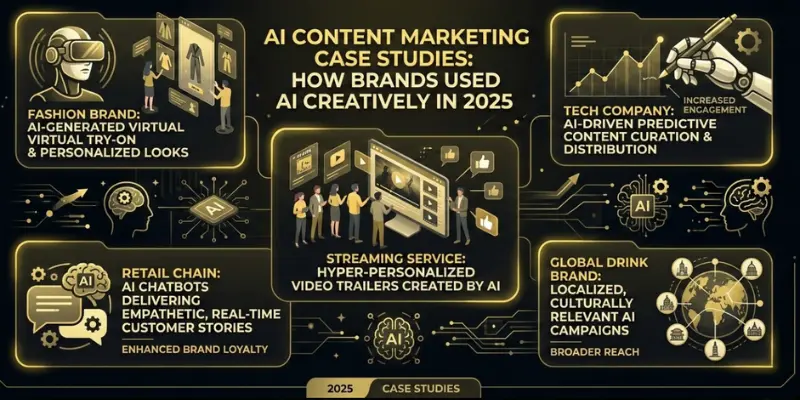
In 2025, some brands created entire marketing campaigns with artificial intelligence. AI wrote ads, designed visuals, and even predicted what customers would buy next. Companies that adopted AI early saw higher engagement and faster growth. Meanwhile, traditional marketers struggled to keep up. These AI content marketing case studies show how brands used AI creatively to transform digital marketing.
AI content marketing uses artificial intelligence tools to plan, create, and optimize digital content. Businesses use these tools to generate blog posts, social media captions, product descriptions, and ad copy. AI can also analyze audience behavior and suggest the best content ideas. As a result, marketers can create targeted campaigns faster than before. Many AI content marketing case studies show that companies using AI improve engagement, reach, and conversion rates.
The Rise of AI Content Strategies in 2025
Setting the Stage: Early 2025 AI Content Strategies
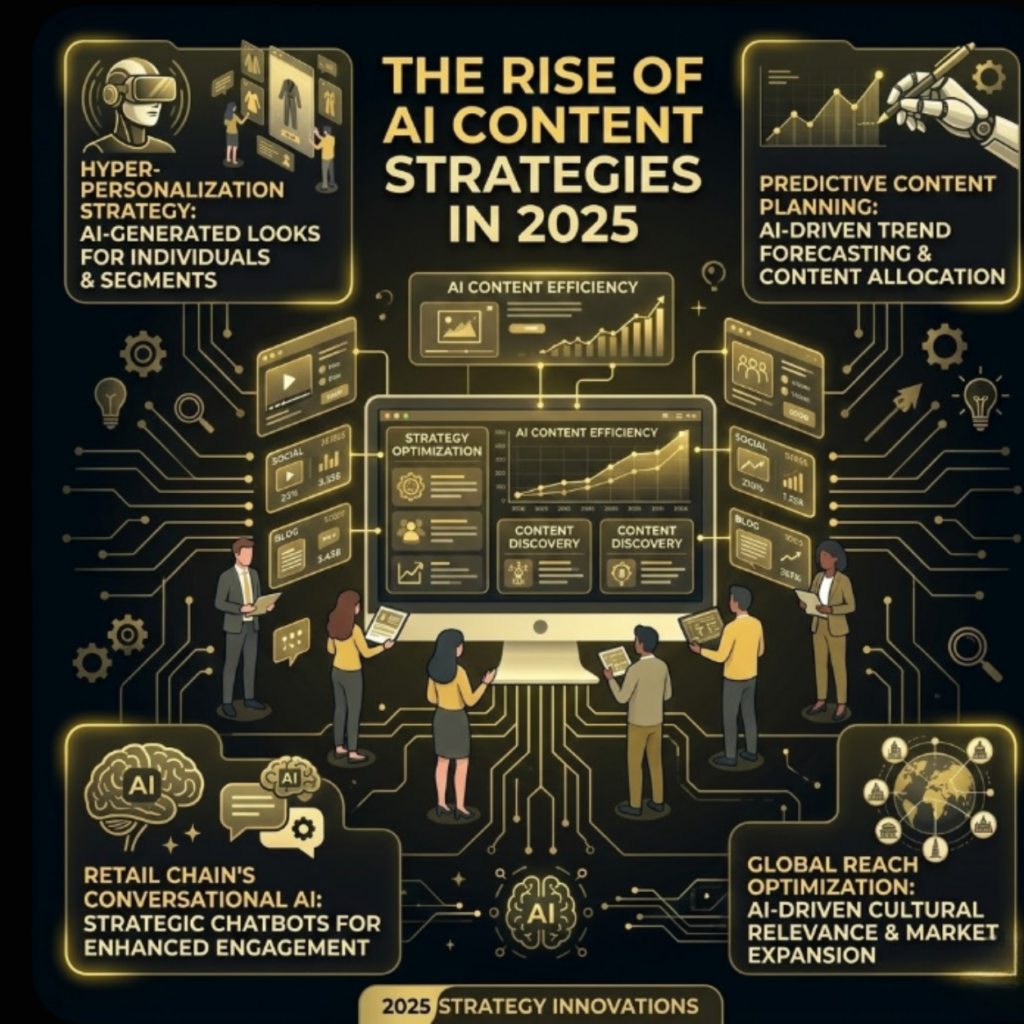
At the beginning of 2025, companies were experimenting with AI tools to support their marketing teams. Many brands started using generative AI for brainstorming content ideas and drafting blog articles. This early adoption helped businesses save time while maintaining content quality. Marketers realized that AI could support creativity instead of replacing it. This discovery encouraged many companies to expand their AI strategies.
Early adopters used AI for simple tasks such as keyword research, content optimization, and social media scheduling. These tools helped teams analyze search trends and customer behavior quickly. Companies began producing more consistent content across multiple platforms. As AI tools improved, marketers gained confidence in automated content creation. These early AI content marketing strategies laid the foundation for broader adoption later in the year.
How AI Content Marketing Evolved Throughout 2025
As the year progressed, AI tools became more advanced and accessible. Brands started using AI not only for writing but also for visual design, audience segmentation, and campaign optimization. This shift helped companies create personalized marketing experiences for their audiences. AI could analyze large amounts of data and suggest content that customers were most likely to engage with. Businesses began seeing measurable results from AI-powered content strategies.
By mid-2025, AI became a central part of many digital marketing workflows. Marketing teams combined human creativity with machine intelligence to produce better content. AI helped identify trending topics, optimize SEO performance, and automate repetitive tasks. Many companies also used AI to test multiple campaign variations and choose the most effective one. These improvements helped brands scale their content marketing faster and more efficiently.
H2: Real Examples of AI in Content Marketing
- Starbucks uses AI to personalize drink recommendations in its mobile app.
- Amazon uses AI algorithms to recommend products based on user behavior.
- Sephora offers an AI beauty advisor that suggests products based on customer preferences.
- BMW used generative AI to design creative advertising visuals.
Common Applications of AI in Content Marketing
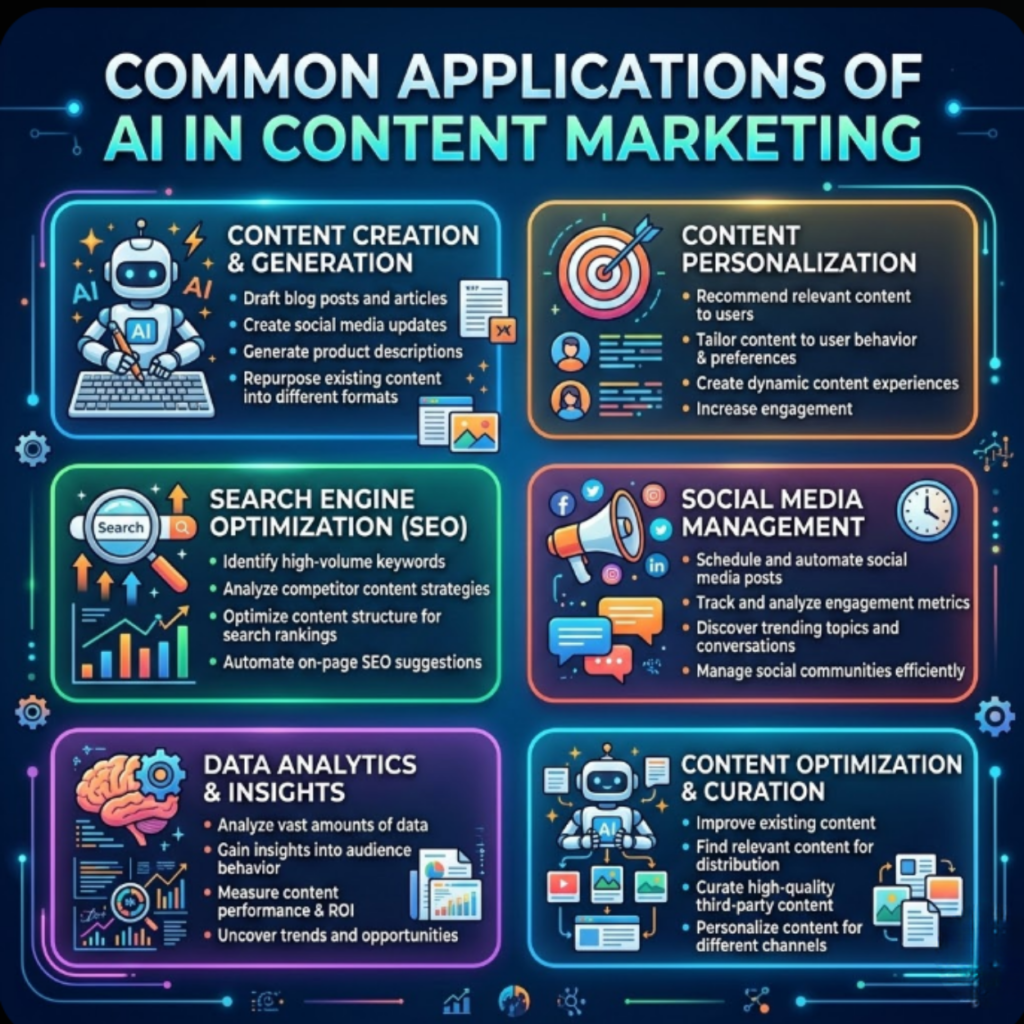
Artificial intelligence supports many aspects of modern marketing. Businesses now use AI tools to generate content, analyze data, and personalize customer experiences. These tools help marketers produce more content while maintaining quality and consistency. Companies also rely on AI to predict audience interests and recommend new content ideas. This combination of automation and insight makes AI a powerful marketing partner.
Some of the most common AI applications in content marketing include:
- AI blog writing and copy generation
- Personalized email marketing campaigns
- Automated social media content creation
- AI-driven advertising optimization
- Customer segmentation and targeting
These applications appear frequently in AI content marketing case studies. Businesses that adopt these tools often improve efficiency and campaign performance. AI allows marketers to focus on strategy while automation handles repetitive tasks.
AI Content Marketing Case Studies from Leading Brands
Real-world examples help marketers understand how AI works in practice. Many global companies have experimented with AI-driven campaigns. These case studies reveal how brands use artificial intelligence to improve engagement, creativity, and personalization. By studying successful campaigns, businesses can learn how to implement their own AI marketing strategies. The following examples highlight some of the most innovative AI content marketing case studies.
| Brand | AI Strategy | Marketing Impact |
| Starbucks | Predictive personalization | Improved customer experience |
| Amazon | AI recommendation engine | Increased conversions |
| Sephora | AI beauty advisor | Enhanced customer engagement |
| BMW | AI generated advertising | Creative brand storytelling |
| Heinz | AI visual campaign | Viral marketing success |
| Nutella | AI product design | Unique brand identity |
Starbucks – Predictive Personalization with AI
Starbucks is one of the best-known examples of AI in marketing. The company uses artificial intelligence to analyze customer purchasing behavior. This system recommends personalized offers through the mobile app. Customers receive drink suggestions based on previous orders and location data. The personalized experience increases customer loyalty and engagement.
The Starbucks AI engine analyzes millions of transactions every day. It predicts what customers might want to order next. This insight allows the brand to deliver highly relevant promotions. As a result, Starbucks improves customer satisfaction and boosts sales. Many AI marketing experts consider this one of the most successful AI content marketing case studies.
Amazon – AI Recommendation Engine for Content and Products
Amazon has long used artificial intelligence to recommend products. The company’s AI system analyzes browsing history, purchases, and search behavior. Based on this data, Amazon suggests products that customers are likely to buy. This recommendation engine is a major driver of Amazon’s revenue. It also improves the shopping experience for millions of users.
The recommendation system works by studying patterns in customer behavior. It identifies relationships between products and user interests. This allows Amazon to personalize product pages and marketing emails. Customers often discover new products through these recommendations. As a result, Amazon achieves higher conversion rates and stronger customer retention.
Sephora – AI Beauty Advisor and Customer Engagement
Sephora uses artificial intelligence to help customers choose beauty products online. The company introduced an AI-powered beauty advisor that provides personalized product suggestions. Customers answer a few questions about their skin type and preferences. The system then recommends suitable products based on this information. This approach improves the online shopping experience.
The AI beauty advisor also helps Sephora create targeted content campaigns. The brand can send personalized product recommendations and tutorials to customers. This strategy increases engagement across email and social media channels. Customers feel more confident about their purchases. As a result, Sephora strengthens brand trust and customer loyalty.
BMW – Generative AI Advertising Campaign
BMW explored generative AI to create visually striking marketing campaigns. The company used AI to design artistic backgrounds for vehicle images. These visuals combined technology and creativity in a unique way. The campaign attracted attention across digital and social media platforms. It showed how AI can enhance creative storytelling.
The generative AI system produced multiple design variations quickly. Marketing teams selected the most compelling visuals for advertisements. This approach reduced production time while increasing creative possibilities. BMW demonstrated that AI can support designers rather than replace them. The campaign became a strong example of innovation in AI marketing.
Heinz – “AI Ketchup” Creative Campaign
Heinz launched one of the most viral AI marketing campaigns in recent years. The company asked an AI image generator to draw pictures of ketchup. Interestingly, the AI often produced images that looked like Heinz bottles. This surprising result became the core idea of the campaign. The brand used the images in social media and advertisements.
The campaign demonstrated how AI can inspire creative marketing ideas. Heinz combined humor with technology to capture audience attention. The content quickly spread across social media platforms. Many marketers discussed the campaign as a brilliant use of AI creativity. It remains one of the most talked-about AI content marketing case studies.
Nutella – AI Generated Product Designs
Nutella used artificial intelligence to create millions of unique jar designs. The AI system generated different patterns for each label. No two jars were exactly the same. This concept made every product feel unique and collectible. Customers loved the creative packaging.
The campaign showed how AI can personalize physical products. Nutella sold millions of jars during the campaign. The unique designs encouraged customers to share photos on social media. This organic promotion helped the campaign reach a wider audience. It also strengthened Nutella’s brand identity.
Why Brands Are Investing in AI Content Marketing
Brands are investing heavily in AI because digital marketing has become more competitive than ever. Companies must produce large amounts of content to stay visible online. Artificial intelligence helps marketers create content faster and with better data insights. This allows businesses to reach the right audience at the right time. AI tools also reduce manual workload for marketing teams.
Another reason brands adopt AI is efficiency. AI-powered marketing platforms analyze customer data and suggest better content strategies. These insights help businesses improve engagement and conversions. Many AI content marketing case studies show that brands using AI achieve higher ROI. As a result, companies now consider AI a key part of their marketing strategy.
Benefits of Using AI in Content Strategy
Artificial intelligence provides several advantages for modern marketing teams. Businesses can automate repetitive tasks and focus more on creative work. AI also improves the speed of content production across blogs, emails, and social media. Companies can test multiple campaign versions and find the best performing one quickly. This flexibility helps marketers adapt to changing trends.
Here are some major benefits businesses gain from AI content strategies:
- Faster content creation
- Better audience targeting
- Improved SEO performance
- Data-driven marketing decisions
- Higher marketing efficiency
These benefits appear frequently in successful AI content marketing case studies. Brands that adopt AI often see better engagement and stronger customer relationships.
AI Tools That Power Modern Content Marketing
Many powerful AI tools are now available for marketers. These platforms help with writing, design, keyword research, and analytics. AI tools can generate blog outlines, suggest headlines, and optimize content for search engines. They also help businesses manage social media campaigns more efficiently. As a result, marketing teams can scale their efforts without increasing workload.
Below is a table showing common AI tools used in content marketing:
| AI Tool Type | Purpose |
| AI writing tools | Blog posts, copywriting |
| SEO AI tools | Keyword research, optimization |
| AI design tools | Visual content creation |
| AI analytics platforms | Audience insights |
| AI automation tools | Social media scheduling |
These technologies are often highlighted in AI content marketing case studies. Businesses that use the right tools can improve productivity and campaign performance.
Challenges of Using AI in Content Marketing
Although AI offers many advantages, businesses also face challenges when adopting it. One major concern is maintaining originality and brand voice. AI-generated content may sound generic if not edited carefully. Marketers must review and refine the content before publishing it. Human oversight remains essential for maintaining quality.
Another challenge is data privacy and ethical use of AI. Companies must ensure they handle customer data responsibly. Some audiences may also feel uncomfortable with fully automated communication. Businesses must balance automation with authenticity. Successful AI content marketing case studies show that brands overcome these challenges through responsible AI use.
How Small Businesses Can Use AI Content Marketing
AI is no longer limited to large corporations. Small businesses can also benefit from affordable AI marketing tools. These tools help entrepreneurs create professional content without hiring large teams. AI can assist with blog writing, product descriptions, and social media posts. This allows small businesses to compete with bigger brands online.
Small companies can start with simple AI strategies:
- Use AI tools for keyword research
- Generate blog content ideas
- Automate social media posts
- Analyze customer behavior
- Improve SEO performance
Many small business success stories now appear in AI content marketing case studies. With the right approach, even small teams can achieve impressive marketing results.
How to Build an AI-Powered Content Strategy
Creating an AI-powered content strategy requires planning and clear goals. Businesses must first understand their audience and marketing objectives. AI tools should support these goals rather than replace human creativity. Companies should also monitor results and adjust strategies regularly. A structured approach ensures that AI delivers real value.
A simple framework for building an AI content strategy includes:
- Define content goals
- Research audience behavior
- Use AI tools for content creation
- Optimize content for SEO
- Analyze results and improve campaigns
Many successful AI content marketing case studies follow this process. By combining technology and strategy, brands can build effective and scalable marketing systems.
Emerging AI Content Marketing Innovations Brands Are Testing
Artificial intelligence continues to transform digital marketing strategies. Brands are exploring new ways to combine AI with creativity and storytelling. These innovations help marketers produce engaging content at scale. AI also allows companies to experiment with new forms of digital interaction. Many businesses see these technologies as the future of content marketing.
Some emerging AI marketing innovations include:
- AI generated visual and video content
- AI influencers and virtual brand ambassadors
- Automated content personalization
- predictive marketing analytics
These technologies are still evolving. However, early experiments show strong results. Many companies believe AI will become a core part of future marketing strategies.
Key Trends That Defined AI Content Marketing in 2025
Several major trends shaped AI marketing in 2025. Businesses focused on combining human creativity with machine intelligence. This collaboration helped marketers produce better campaigns. AI tools also became more affordable and accessible for small businesses. As a result, more companies started experimenting with AI content strategies.
Key trends included:
- AI powered content creation
- Hyper personalized marketing experiences
- Automated campaign testing
- Data driven content optimization
These trends appear in many AI content marketing case studies. Companies that adopted these strategies often achieved better engagement and stronger ROI.
Key Lessons from Successful AI Content Marketing Case Studies
The rapid growth of AI marketing taught businesses several important lessons. Companies discovered that AI works best when combined with human creativity. Technology can generate ideas and analyze data, but human insight remains essential. Marketers also learned the importance of ethical AI usage. Transparency and trust are critical in modern marketing.
Brands also realized that AI requires proper strategy and planning. Simply adopting AI tools does not guarantee success. Businesses must align AI technology with their marketing goals. Training teams to use AI effectively is also important. These lessons will shape future AI marketing strategies.
The Future of AI Content Marketing (2026 and Beyond)
AI will likely become even more powerful in the coming years. New tools will improve content generation, audience targeting, and campaign optimization. Businesses will use predictive analytics to understand customer behavior more accurately. This will allow marketers to create highly personalized experiences. The future of marketing will be both data driven and creative.
Experts predict several developments in the next few years:
- Advanced AI content generation tools
- Smarter marketing automation systems
- Deeper customer personalization
- Stronger collaboration between humans and AI
These innovations will reshape digital marketing strategies. Companies that adopt AI early may gain a strong competitive advantage.
Key Takeaways from AI Marketing Case Studies
AI content marketing case studies reveal how technology can transform marketing strategies. Brands using AI can produce more content, personalize experiences, and analyze performance quickly. However, successful campaigns always combine technology with creative thinking. AI should support human marketers rather than replace them.
Key takeaways include:
- AI improves efficiency in content creation
- Personalization increases customer engagement
- Data insights guide better marketing decisions
- Human creativity remains essential
Businesses that understand these principles can build stronger content strategies.
FAQs
What is AI content marketing?
AI content marketing refers to using artificial intelligence tools to create, optimize, and distribute marketing content. These tools help marketers generate ideas, write content, and analyze audience behavior. AI can also personalize marketing messages based on customer data. This improves engagement and campaign effectiveness. Many companies now use AI as part of their digital marketing strategy.
How are brands using AI in marketing?
Brands use AI for many marketing activities. These include content creation, email marketing, customer segmentation, and predictive analytics. AI tools also help businesses optimize advertising campaigns. By analyzing large data sets, AI identifies patterns in customer behavior. This insight helps marketers make smarter decisions.
Can small businesses use AI for content marketing?
Yes, small businesses can benefit from AI marketing tools. Many affordable platforms offer AI writing, SEO optimization, and social media automation. These tools help small teams produce professional content quickly. AI can also provide insights about customer preferences. This allows small businesses to compete with larger brands.
Is AI replacing marketers?
AI is not replacing marketers. Instead, it acts as a powerful support tool. AI can automate repetitive tasks such as data analysis and content drafting. This allows marketers to focus on strategy and creativity. Human expertise remains essential for effective marketing campaigns.
What are the risks of using AI in marketing?
Using AI in marketing comes with some risks. These include data privacy concerns and potential inaccuracies in generated content. Businesses must ensure that AI tools follow ethical guidelines. Human oversight is necessary to maintain quality and accuracy. Responsible use of AI helps protect brand reputation.
How can companies measure the ROI of AI marketing?
Companies can measure AI marketing ROI using several metrics. These include engagement rates, conversion rates, and customer acquisition costs. Marketers should compare campaign performance before and after adopting AI tools. Analytics platforms help track the impact of AI-powered strategies. Clear measurement ensures that AI investments deliver real value.
Conclusion
AI is changing how brands approach content marketing. Companies around the world are experimenting with creative AI campaigns and data-driven strategies. These AI content marketing case studies show that technology can unlock new levels of innovation. Businesses that embrace AI can create more engaging and personalized experiences. The future of marketing will belong to brands that combine human creativity with artificial intelligence.