
Introduction
Analytics tools and metrics 2025 are no longer about collecting more data. They are about collecting the right data and turning it into fast, confident decisions. In 2025, teams are overwhelmed with dashboards, tools, and metrics that look impressive but rarely drive real action. That is why mastering analytics tools and metrics 2025 has become a competitive advantage, not just a technical skill.
This guide cuts through the noise. You will learn which analytics tools are worth monitoring, which metrics actually influence growth, and how modern teams use data to move faster with fewer surprises. Whether you run a SaaS company, manage marketing campaigns, or lead product decisions, this article will help you build a smarter analytics strategy for 2025 and beyond.
Why Analytics in 2025 Looks Very Different

Analytics has shifted from static reporting to real-time intelligence. Privacy laws, AI, and user behavior changes have reshaped how data is collected and used. Teams that still rely on outdated metrics struggle to understand what is really happening. Modern analytics focuses on insight, not volume.
The biggest change is intent. Businesses no longer ask “what happened” but “what should we do next.” Tools now emphasize predictive analytics, automation, and decision-ready dashboards. This shift makes analytics tools and metrics 2025 fundamentally different from what worked even two years ago.
The Core Analytics Metrics That Matter in 2025
The most important analytics metrics in 2025 focus on outcomes, not activity. Page views and raw traffic numbers mean little without context. What matters is how users behave, convert, and retain. Metrics must connect directly to business value.
The strongest teams track fewer metrics but review them more often. These metrics guide decisions across marketing, product, and operations. Below are the most impactful categories you should prioritize.
For example, a SaaS company might track Customer Acquisition Cost (CAC) alongside Customer Lifetime Value (CLV) to understand growth efficiency. If CAC is rising faster than CLV, it signals that marketing spend is becoming unsustainable. This insight helps teams adjust pricing, onboarding, or acquisition channels before revenue is impacted.
Key Metrics to Monitor
- Customer Acquisition Cost (CAC)
- Customer Lifetime Value (CLV)
- Conversion Rate by channel
- Engagement depth (time, scroll, interactions)
- Retention and churn rate
- Revenue per user
- First-party data signals
Marketing Analytics Metrics That Drive Growth
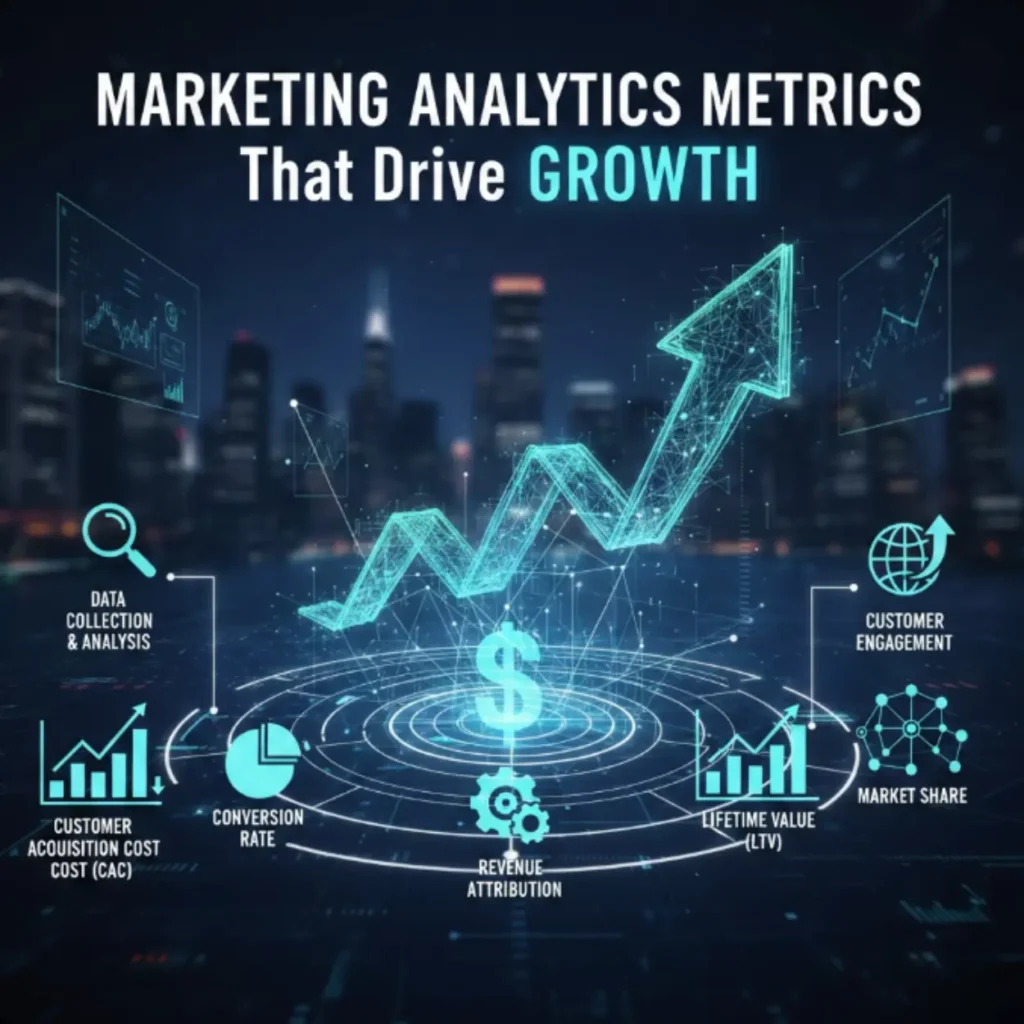
Marketing analytics in 2025 is no longer channel-centric. It is customer-centric. The focus has moved from impressions and clicks to contribution and ROI. Teams want to know which efforts actually grow revenue.
Marketing leaders now rely on attribution models that blend first-party data with predictive insights. This approach improves budget allocation and campaign planning. It also reduces wasted spend on channels that look busy but do not convert.
Marketing analytics metrics must answer one question clearly. Are your campaigns moving users closer to revenue? If the metric cannot answer that, it should be removed.
Example (Marketing Campaigns):
For example, a marketing team running paid ads may notice high click-through rates but low assisted conversions. This shows the campaign creates awareness but does not drive final purchases. The insight helps shift budget toward channels that contribute directly to revenue instead of vanity performance.
Customer Behavior Metrics You Cannot Ignore
Customer behavior metrics reveal intent, friction, and opportunity. They show how users interact with your product, website, or platform. In 2025, these metrics are more valuable than traffic numbers alone.
Behavior metrics help teams improve UX, messaging, and conversion flows. They also power personalization and automation. When used correctly, they reduce guesswork across teams.
Example (E-commerce):
In an e-commerce business, engagement depth and funnel drop-off metrics help identify where users abandon the checkout process. For instance, if most users leave at the payment step, it may indicate trust issues or limited payment options. Fixing this single step can immediately improve conversion rates.
High-Impact Behavior Metrics
- Funnel drop-off points
- Session depth
- Feature adoption rate
- Repeat visit frequency
- Time to first value
Predictive Analytics Metrics for Smarter Forecasting
Predictive analytics metrics help teams move from reactive to proactive decisions. These metrics use historical data and machine learning models. They forecast outcomes like churn, demand, and revenue. This reduces uncertainty across teams. It also improves long-term planning accuracy.
In 2025, predictive metrics are especially valuable for growth and finance teams. Examples include churn probability score, revenue forecasting accuracy, and demand elasticity. These metrics allow early intervention before problems escalate. Businesses using predictive analytics tools 2025 gain speed and confidence. Forecasting becomes a competitive advantage rather than a guessing game.
Infrastructure and Performance Metrics That Prevent Downtime
Infrastructure metrics ensure systems remain fast, stable, and available. Downtime directly impacts revenue and trust. In 2025, performance expectations are higher than ever. Even small delays hurt user experience. Monitoring must be continuous and intelligent.
Key infrastructure metrics include latency, error rates, throughput, and resource utilization. These metrics reveal system health across cloud and hybrid environments. Modern monitoring platforms surface anomalies automatically. This reduces manual troubleshooting time. Reliable infrastructure metrics protect both users and revenue.
Revenue and ROI Metrics Leadership Cares About
Leadership teams focus on metrics that reflect business impact. Revenue-based analytics metrics matter more than surface-level engagement. These metrics help executives evaluate growth efficiency. They also guide strategic investments. Clarity at this level drives better decisions.
Important revenue metrics include customer lifetime value, revenue per user, and marketing ROI metrics. These numbers connect analytics to profitability. In 2025, dashboards must clearly show cause and effect. Leaders expect real-time visibility into financial performance. Analytics tools and metrics 2025 must support this demand.
Cross-Team Analytics Metrics for Better Collaboration
Analytics should unite teams, not isolate them. Cross-team metrics create shared understanding across marketing, product, and engineering. They reduce misalignment and conflicting priorities. Everyone works from the same data. This improves execution speed.
Examples include shared conversion funnels, customer journey metrics, and system reliability scores. These metrics create accountability across departments. Teams collaborate instead of blaming each other. In 2025, unified analytics is essential for scale. Silos slow growth and innovation.
Role-Based Dashboards for Analytics Tools and Metrics 2025
Not every team needs the same analytics view. Role-based dashboards improve focus and usability. They reduce cognitive overload from unnecessary data. This makes analytics actionable. Adoption increases across teams.
Marketing teams track campaign performance metrics. Product teams monitor feature adoption and retention. Leadership views revenue and growth trends. Custom dashboards align metrics with responsibility. This is a core best practice for analytics tools and metrics 2025.
Data Quality Metrics You Should Actively Monitor
Poor data quality leads to poor decisions. In 2025, data trust is non-negotiable. Teams must monitor data accuracy and completeness. Analytics without quality checks is risky. Errors compound quickly.
Important data quality metrics include missing data rate, event tracking accuracy, and data freshness. These metrics ensure insights are reliable. Automated alerts help detect issues early. Clean data strengthens every analytics use case. Strong data quality underpins all analytics tools and metrics 2025.
Analytics Governance and Compliance Metrics
Analytics governance ensures responsible data usage. Regulations continue to expand globally. Compliance metrics protect businesses from legal and reputational risk. Governance also builds customer trust. This matters more each year.
Key governance metrics include consent coverage rate, data access logs, and compliance audit status. These metrics ensure analytics systems remain secure. They also support transparency initiatives. In 2025, governance is part of analytics strategy. Ignoring it is no longer an option.
AI-Powered Analytics Tools and Metrics in 2025
AI is no longer optional in analytics. It is the engine behind faster insights and smarter alerts. AI-powered analytics tools detect patterns humans miss and surface issues before they escalate. This is especially critical for large or fast-growing systems.
Modern platforms use AI to reduce noise. Instead of hundreds of alerts, teams receive prioritized insights. This shift saves time and prevents burnout across engineering and marketing teams.
Examples of AI-Driven Observability
Platforms like Grafana Cloud use machine learning to correlate metrics, logs, and traces. This helps teams understand system health in real time. Meanwhile, Datadog applies AI to anomaly detection and root-cause analysis at scale.
Privacy-First Analytics Tools and Metrics for 2025
Privacy changes have permanently altered analytics. Third-party cookies are fading, and regulations continue to expand. In response, first-party data has become the foundation of analytics tools and metrics 2025.
Privacy-first analytics focuses on consent, transparency, and ownership. Businesses that adapt early gain more reliable data and stronger customer trust. Those who delay lose visibility and accuracy.
Key Privacy-First Metrics
- Consent opt-in rate
- First-party event tracking
- Authenticated user behavior
- Data completeness score
Real-Time Analytics for Faster Decisions
Real-time analytics is no longer just for engineers. Marketing, product, and leadership teams all rely on live data in 2025. Delayed reporting leads to delayed decisions. Speed matters.
Real-time dashboards help teams respond to spikes, drops, and anomalies immediately. This is especially important during launches, campaigns, or incidents. Businesses that act faster gain an edge.
However, real-time data must be filtered. Not everything deserves attention. The goal is clarity, not constant distraction.
Best Analytics Tools and Metrics to Monitor in 2025
Choosing the right analytics tools is as important as choosing the right metrics. A bloated stack creates confusion. A focused stack creates clarity. The best analytics tools in 2025 integrate data across teams and systems.
Below is a comparison of commonly used analytics tool categories and their core value.
Analytics Tool Comparison Table
| Tool Category | Primary Use | Best For |
| Observability Platforms | System & performance monitoring | SaaS, DevOps |
| Product Analytics | User behavior tracking | Product teams |
| Marketing Analytics Tools 2025 | Campaign & ROI tracking | Marketers |
| Business Intelligence Tools 2025 | Data visualization & reporting | Leadership |
| Predictive Analytics Tools 2025 | Forecasting & modeling | Growth teams |
How to Align Metrics With Business Goals
Metrics without alignment create busy work. Every metric should map to a business outcome. This alignment ensures analytics drives action, not confusion.
Start by defining success clearly. Then choose metrics that indicate progress toward that goal. Review metrics regularly and remove those that no longer serve a purpose.
Alignment also improves cross-team collaboration. When everyone speaks the same data language, decisions become faster and more confident.
Common Analytics Mistakes to Avoid in 2025
Many teams still track too much data. Others track the wrong data. Both lead to poor decisions. In 2025, simplicity is a strength.
Vanity metrics may look impressive but rarely offer real insight. Dashboards that no one checks only add clutter. Overlapping tools without clear value create confusion instead of clarity.The best analytics setups are boring by design. They focus on clarity, relevance, and speed.
Actionable Tips to Improve Your Analytics Stack
- Audit your current metrics quarterly
- Remove metrics that do not drive decisions
- Prioritize first-party data collection
- Use AI alerts instead of manual monitoring
- Build dashboards by role, not by tool
Product Analytics Metrics That Shape Better Experiences
Product analytics metrics show how users interact with features. They reveal friction, confusion, and drop-off points. In 2025, experience quality directly impacts retention. Small UX issues now cause major churn. Metrics must guide improvement, not just observation.
Important product metrics include feature adoption rate, time to first value, and usage frequency. These metrics help teams prioritize roadmap decisions. They also validate whether features solve real problems. Product analytics tools 2025 focus on behavior, not assumptions. Better metrics lead to better products.
Conversion Analytics Metrics That Improve Funnel Performance
Conversion metrics explain why users take action or leave. Funnels are more complex in 2025. Users interact across devices and channels. Tracking conversions accurately is harder. That makes clarity even more important.
Key conversion metrics include step-by-step drop-off rate, assisted conversions, and channel-specific conversion value. These metrics help marketers optimize flows. They remove guesswork from optimization decisions. Conversion analytics connects effort with outcomes. This is a core pillar of analytics tools and metrics 2025.
Retention and Churn Metrics That Protect Long-Term Growth
Growth does not come from acquisition alone. Retention now defines sustainability. In 2025, keeping users is cheaper than acquiring new ones. Churn silently kills momentum. Metrics must expose it early.
Retention metrics include cohort retention, churn rate, and re-engagement frequency. These metrics reveal loyalty patterns. They also highlight product-market fit issues. Predictive churn metrics add early warnings. Retention analytics drives stable growth.
Operational Analytics Metrics for Smarter Execution
Operational metrics measure how efficiently teams work. They reveal bottlenecks and delays. In fast-moving environments, inefficiency compounds quickly. Visibility improves execution quality. Data-driven operations outperform intuition-based ones.
Operational analytics metrics include cycle time, incident resolution time, and deployment frequency. These metrics improve accountability. They also support better resource allocation. In 2025, operations analytics is no longer optional. It is a performance multiplier.
Attribution Metrics in a Cookieless World
Attribution has changed dramatically. Traditional last-click models no longer reflect reality. Privacy changes reduce tracking visibility. In 2025, attribution must be adaptive. First-party data becomes the foundation.
Modern attribution metrics include contribution modeling, blended attribution scores, and incremental lift. These metrics reflect real influence. They help teams invest smarter. Attribution analytics is now probabilistic, not perfect. Accepting this shift is essential.
Alerting and Signal Metrics That Reduce Noise
Too many alerts slow teams down. Noise hides real problems. In 2025, alert quality matters more than alert quantity. Metrics must surface signal, not panic. Intelligent alerting improves focus.
Signal-based metrics include anomaly confidence score, alert frequency, and impact severity. These metrics prioritize issues. They reduce burnout across teams. AI-driven alerting is becoming standard. Smart alerting is a key strength of analytics tools and metrics 2025.
Benchmarking Metrics to Measure Competitive Performance
Internal metrics alone are not enough. Benchmarking provides external context. It shows how performance compares to peers. This helps set realistic goals. Competitive awareness improves strategy.
Benchmarking metrics include industry conversion averages, performance percentiles, and growth rate comparisons. These metrics prevent blind spots. They also guide leadership decisions. In 2025, benchmarking analytics informs positioning. Data-driven competition beats guesswork.
Scalability Metrics for Growing Tech Stacks
Scalability metrics indicate future readiness. Growth often breaks systems silently. In 2025, scaling without visibility is risky. Metrics must show stress points early. Preparation prevents failure.
Scalability metrics include load capacity, cost per request, and performance degradation thresholds. These metrics guide infrastructure planning. They protect user experience during growth. Scalable analytics supports confident expansion. This is critical for SaaS and cloud-native teams.
Turn Insights Into Impact with Mugenz
You’ve seen how the right analytics tools and metrics in 2025 drive smarter decisions. Now it’s time to act on those insights with digital solutions built for real-world growth.
Choose your path and get started today:
- Healthcare Solutions
Optimize patient engagement, streamline operations, and stay compliant with data-driven digital tools built for modern healthcare.
Explore Healthcare Solutions - Real Estate Solutions
Turn data into deals with smarter lead tracking, conversion analytics, and performance-driven digital platforms for real estate growth.
Discover Real Estate Solutions - NGO Solutions
Maximize impact with transparent analytics, donor insights, and scalable digital systems designed for mission-driven organizations.
See NGO Solutions
Ready to grow smarter?
Click to explore Mugenz services, contact our team, or sign up for updates and see how data-backed digital solutions can move your organization forward—faster and with confidence.
Conclusion
Analytics success in 2025 is not about having more dashboards—it is about having clearer, more actionable answers. The right analytics tools and metrics 2025 enable teams to move faster, reduce risk, and grow with confidence.
By prioritizing outcome-driven metrics, privacy-first data, and AI-powered insights, businesses can transform analytics into a true strategic advantage. Review your analytics stack, simplify what you measure, and commit to clarity. The teams that do this will lead their markets while others struggle to keep up
FAQs
What are the most important analytics metrics in 2025?
The most important analytics metrics in 2025 include conversion rate, retention rate, customer lifetime value, engagement depth, and first-party behavior signals. These metrics connect directly to revenue and long-term growth.
Which analytics tools are best for 2025?
The best analytics tools in 2025 depend on your needs. Observability platforms, product analytics tools, and business intelligence tools remain essential. AI-powered and privacy-first platforms offer the most long-term value.
Why is first-party data so important in 2025 analytics?
First-party data is more accurate, compliant, and reliable. As third-party tracking declines, businesses that rely on first-party data maintain visibility and trust.
How often should analytics metrics be reviewed?
Core metrics should be reviewed weekly or monthly. Strategic metrics should be reviewed quarterly. Real-time alerts should trigger immediate action when thresholds are crossed.
How do I reduce analytics complexity?
Focus on fewer metrics. Consolidate tools. Build role-specific dashboards. Remove anything that does not influence decisions.